
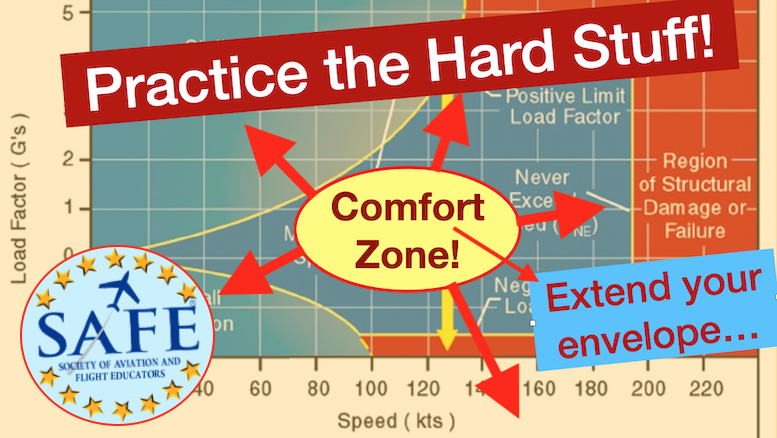
If you want to improve as a pilot, at any level, you must stretch your known skills a little further and practice in the “struggle zone.” Just going out and repeating what you already know -usually solo- will not create improvement (this is a common educational fallacy). You must practice just beyond your comfort zone (usually dual): “deliberate (deep) practice!” You need to struggle at the edge of your abilities. But not sofar that you are flailing to extend your envelope! Optimal challenge is the key. Varying your practice (interleaving) is also essential to progress toward your goals of excellence and mastery.
 Practicing in this “struggle zone” and working relentlessly toward a well-defined goal builds skills six times faster than usual techniques. Simple repetition of what you already know is wasted time (and can lead to a lack of motivation eventually). Working instead on the edge requires a good CFI and a little sweat (and FUN!) You gotta work at it (and pay a talented educator). Even CFIs and DPEs, need to access mentoring to build and expand skills.
“The sweet spot: that productive, uncomfortable terrain located just beyond our current abilities, where our reach exceeds our grasp. Deep practice is not simply about struggling; it’s about seeking a particular struggle, which involves a cycle of distinct actions.” Talent Code by Daniel Coyle
“Deep practice is built on a paradox: struggling in certain targeted ways—operating at the edges of your ability, where you make mistakes—makes you smarter. Or to put it a slightly different way, experiences where you’re forced to slow down, make errors, and correct them—as you would if you were walking up an ice-covered hill, slipping and stumbling as you go—end up making you swift and graceful without your realizing it.” Talent Code by Daniel Coyle
Struggle is not optional—it’s neurologically required: in order to get your skill circuit to fire optimally, you must by definition fire the circuit suboptimally; you must make mistakes and pay attention to those mistakes; you must slowly teach your circuit. You must also keep firing that circuit—i.e., practicing—in order to [build and] keep myelin functioning properly Talent Code by Daniel Coyle
As far as the educators who provide this “turbo learning,” Coyle calls them “talent whisperers.” Usually quiet and offering minimal and very precise direction, there are many useful tips in Coyle’s book for educators about creating technical mastery.
CFI and DPE Mentoring at SAFE! We have expanded our mentoring program to allow new DPEs access to professionals (like SAFE DPEs Hobie Tomlinson and Bill Ziesnich – each of whom has been a DPE for 44 years!) The recent FAA ARAC Report recommends mentoring for new DPEs; available now from SAFE.
SAFE’s members … are highly accomplished people with a lot of valuable experience to transfer. So let me congratulate you on starting the SAFE Aviation Educator Mentoring Program. I especially like the program statement that “Even experienced educators may occasionally want or need insights when teaching in new aircraft, or with new technologies and techniques.” — Former FAA Administrator Babbitt
Join SAFE  and get great benefits (1/3 off ForeFlight!) This supports our mission of increasing aviation safety by promoting excellence in education. Our FREE SAFE Toolkit App puts required pilot endorsements and experience requirements right on your smartphone and facilitates CFI+DPE teamwork. Our CFI insurance was developed by SAFE specifically for CFIs (and is the best value in the business).


Tell us what *you* think!