
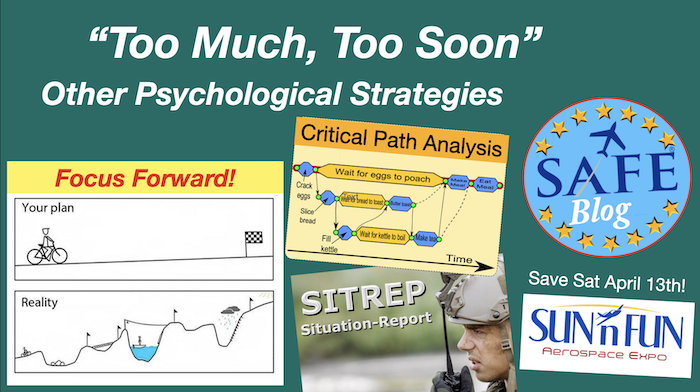
 During primary training, most learners want to get to landings way too soon. Similarly, during IFR training, pilots push to begin working on approaches before they have mastered basic IFR control (“Gotta get to my Airbus dude.”) In both cases, a CFI can get lured into this error of “teaching final form” before the basics are mastered.”Too much, too soon” reveals a failure to manage the pace of instruction; the most common instructional error.
 Many CFIs rationalize this error as “motivating the learner.” But “too much, too soon” leads to dangerous excursions, and learner frustration (CFI burnout). Accelerating the training pace beyond learner comprehension and mastery prevents real learning. The secret to managing a pushy learner is to set challenging, but realistic, sub-goals that must be mastered before the next step is taken. “6X learning” occurs in this “struggle zone” where the educator provides “optimal challenge.” “Too much, too soon” leads to “flailing.” Read “incremental mastery” for a more detailed explanation of this process. One of the critical skills for every successful CFI is pushing back with “pushy learners!” (That command authority thing…)
 The other side of the instructional pacing problem is overly slow exposure of new challenges. This comes from insisting on perfection in every maneuver before moving further. Studies have shown that “interleaving” and variety of exposure “before ultimate success” leads to faster and more enduring learning. Remember, though perfection is a worthy goal that should always be kept in sight, “perfectionism” is a psychological problem! Initial pre-solo standards should have some grace as mastery is built. FIrst, get all the darts on the dartboard and then tighten the grouping. With “incremental mastery,” a learner’s personal standards will tighten up the tolerances with practice. Furthermore, the pursuit of excellence has to be internally embraced by your learner. Perfection enforced by the CFI in a draconian external manner is demotivating and counterproductive (yes, I spent some time in Catholic school)
Focus Forward!
 Flight tests are often ruined by the self-sabotage of focusing on past errors. As soon as something does not go perfectly, a pilot can melt into a pool of self-doubt and pity. Though all good pilots strive for excellence, errors will happen; keep flying! Self-doubt and recrimination prevent effective performance and jeopardize safety. Savvy, well-trained pilots “Focus Forward” on the next challenge (positive mindset). Developing a forward focus brings your full energy and talent to the operation. This is true of both evaluations and high-workload flight situations. There is plenty of time after a flight for reflective analysis and resolutions for future improvement.
 A critical part of a forward focus is a realistic evaluation of the current situation. The military calls a “sitrep: Situation Report ” This tool accurately calibrates resources: “What do we have and what is our current unbiased (non-emotional) status.” This is the “reality check” that lives in the real world, not where we wish we were or what might have happened. Here we are, and decision-making must be based on an accurate and realistic assessment of the current situation. At that point, the best path forward, given the current situation, has to be decided in a clear-eyed fashion. “The perfect” can again be the enemy, since we live in the real world, not Barbie Land.
“Satisficing”
This is a word coined by Dr. Herbert Simon, the original AI researcher, and a savvy psychological economist. As humans, we seldom choose the best but rather select “good enough” for real world survival. “Satisficing” is the psychological state of being able to accept “less than perfect,” in the interest of “the good” and forward motion. Perfectionism can often stop necessary action in its tracks. Satisficing is a choice or pathway that contains all the necessary elements to move forward and achieve success without the delay of waiting for “the perfect.”
 Aligned with the “current situation”and “best available” solution (the first level of situational awareness) is a clear view of the “critical path” forward (level two). “Critical Path Analysis” is an engineering viewpoint that decides all the necessary elements on the path forward toward a successful outcome. It necessarily eliminates many “nice to have” elements to streamline a process for efficiency. In a high-consequence, time-critical world like flying, time and resources are always scarce. The “best choice” is not the “perfect choice” but satisfactory. Aeronautical decision-making starts with what we actually have on hand and makes “the best” choices.
SAFE @ Sun ‘N Fun (50th) in 2024
 If you are a SAFE member headed to Sun ‘N Fun, please save Saturday evening, April 13th for a get-together (~17:00) at the Prop 74 building (next to the exhibit buildings). This is Saturday Airshow night and details are developing (TBD). This will be a light dinner with a couple drinks included for one US President. Lifetime SAFE members get in free and supporting members will be half price. More details soon. Fly safely out there (and often)!
See “SAFE SOCIAL WALL” For more Resources
 Join SAFE and get great benefits. You get 1/3 off ForeFlight and your membership supports our mission of increasing aviation safety by promoting excellence in education. Our FREE SAFE Toolkit App puts required pilot endorsements and experience requirements right on your smartphone and facilitates CFI+DPE teamwork. Our newly reformulated Mentoring Program is open to every CFI (and those working on the rating) Join our new Mentoring FaceBook Group.
 Read our February “SAFE Strategies” for great resources and ideas. See the special landing page on survival kits and techniques. There is also a dedicated landing page with extensive free CFI Resources.
Subscribe for free monthly delivery!

Tell us what *you* think!