DPEs continually witness unsuccessful short-field landings during testing at all levels. Using power correctly (against induced drag "behind the power curve") permits a *slower* approach and precise control of the touchdown. The commercial power-off 180 also requires an understanding of induced drag.
![]()
The short-field landing is probably the most demanding maneuver in the private pilot syllabus. Success on this maneuver requires a precise descent rate while simultaneously maintaining an exact approach airspeed. This is at the edge of the flight envelope all the way into the touchdown. Done correctly, this maneuver demonstrates perfect energy management in the region of reversed command (slower than best glide). The proximity to aerodynamic stall close to the ground necessitates extensive dual training to first achieve safety and then acquire mastery. This is usually the last maneuver flown solo before the flight evaluation (and many flight schools do not even allow this to be flown solo).
The two most common misconceptions that ruin any chance of short-field success are not using power to fly slower approach speeds, or attempting the short-field approach at best-glide airspeed (see the comm. 180 PO). Neither of these techniques will assure the necessary accuracy (though go-arounds are permitted on flight tests).

The ability to adjust power, while simultaneously maintaining a precise, slower airspeed, is what controls the glide path and provides the accurate touchdown. This is the secret to short-field success. Approach at Vg brings too much energy into the level off for a precise touchdown – the most common failure mode on flight tests. To be successful, your airplane must have just enough energy on approach to permit the level-off in ground effect (the stall warning may sound here). The carefully timed power reduction yields the precise touchdown accuracy. Ideally, the power setting in ground effect is just above idle (zero thrust). When reduced to “idle drag,” this creates the immediate touchdown. Watch those Alaska short-field accuracy landings to see extreme versions of the private pilot maneuver (don’t try these at home). Notice the use of power for precision.
The perfect short-field approach is flown in the middle of the power band, balancing power against induced drag while flying slower than best glide. The resulting glide path control and touchdown are amazing. A properly flown short-field approach requires managing a precise airspeed and descent path on the edge of a stall by modulating power and pitch.
…when beginning a suitable final approach, the pilot simultaneously adjusts the power and the pitch attitude to establish and maintain the proper descent angle and airspeed. During a stabilized approach, small changes in the airplane’s pitch attitude and power setting are needed when making corrections to the angle of descent and airspeed. FAA AFM Chapter 9

The best practice for this approach is practicing flight at minimum controllable airspeed (refer to CFI ACS A/O X, Task B) at a safe altitude. Once established and proficient in maintaining level flight at a stabilized airspeed (+/- 2K), add practice descending at precise target rates – managing pitch and power – at a constant airspeed. It is useful to practice a simulated go-around also from this configuration. Powering up has to be followed by a push forward to accelerate to climb speed; you are in “reverse command”here. These skills must be mastered safely at altitude before attempting any short-field approaches close to the ground. (see fallacy of “practicing in final form“)
Carefully determine your target approach airspeed
When a test applicant says their short-field approach speed is “about” some random number in the POH, their attempt in flight is almost surely going to fail; they must have an accurate target speed for success!
So step one is to determine the correct airspeed (fully described in the last blog). Most POHs only give the short-field airspeed at the aircraft’s max. gross weight. This must be carefully “factored” to determine the correct target speed for the condition of the plane and the WX. (Every jet aircraft does this on every landing, so learn this skill now.) Approach speed is based on the actual (usually lower), A/C weight, configuration, and weather conditions.
The old-school method for determining short-field approach speed was simply stalling the plane in landing configuration (at actual weight) on approach, and adding 15-20% for the perfect approach speed. Again, the target approach speed should provide just enough energy to raise the nose to the level and landing position with no float. The last power reduction determines the accuracy. Maintaining this close margin above stall requires precise piloting skill.
Fly a longer final approach
A longer-than-normal final approach allows more time to determine and stabilize the precise airspeed and descent path necessary for the unique conditions. In real backcountry conditions, there are no VASI systems. Relying on the “parallax cueing method” assures a safe glidepath to touchdown. This means lining up the top of the last obstacle with the targeted touchdown point for a clear arrival path.
Specialty landings perfected on a large paved runway during training are only the first step toward *real* short-field proficiency. For your safety, do not assume your “big county airport proficiency” will translate safely to real conditions. Get some dedicated dual on real grass and actual shorter runways for safety.
Expect a much faster level-off landing sequence
Since your energy entering ground effect is so much less, the level off and touch down is a lot faster. The landing level off in ground effect at normal approach speeds ~1.3XVso allows for 2-3 seconds of float. At short-field approach speed, the stall warner will often sound as you round out in ground effect. Carefully timed reduction of any remaining power will create the accurate touchdown you need for short-field accuracy. Lots of practice with a knowledgeable flight instructor is necessary to reach this pinnacle of perfection. All your landings will improve with this hard-won proficiency. Fly safely out there (and often)!


land. A good percentage of jet accidents (overruns) result from too much speed (energy) on final approach (


One of the most powerful aviation learning or teaching tools is mentally exploring hypothetical surprises that any pilot may realistically encounter (e.g. gravity works). Carefully rehearsing the “what ifs” builds an arsenal of ready reaction plans and the important habit of continual situational awareness. Complacency is a common human habit experienced in all activities, but in flying, it can get you hurt. I get a little edgy with pilots who become totally immersed in their “Starlink World” while on autopilot.


There have been
Dr. Mica Endsley
Since almost 80% of accidents occur from errors in basic perception, this is a rich target for improvement. Our human Operating System often misses subtle changes in the “here and now” through “stereotyping” perceptual input (


Motivation is the critical engine that drives human resilience and success. When a new eager learner walks into a flight school, they are curious and motivated; they are ready to go and supercharged. The goal of the educator from the first intro flight through their final checkride is to keep that fire burning. But how do we do that? The answer is “
SAFE webinar


Greg Harden, a well-respected coach at the University of Michigan, took a skinny freshman from California named Tom Brady and helped him become a 7-time Super Bowl winner. When you watch his amazing comeback performances, you wonder, “


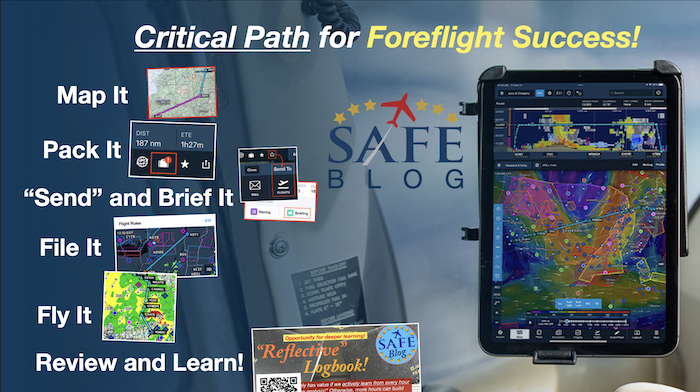
Foreflight is an amazing toolbox of resources that saves time and provides previously unavailable planning insights. Unfortunately, many pilots I work with (testing and training) do not use this app to its full capability. An organized “


Unless you have Starlink running in the back of your aircraft, all that wonderful information you scan on the ground will not be with you in flight. 


If you are flying in a dense traffic situation (radio is buzzing), “eliminating the obvious” is essential (but not actually approved by the “point six five” or the FAR/AIM glossary) In busy airspace the rule is “essential to efficient” communication. At 17:00 in the NYC airspace, on the handoff, it is often too busy to even check-on with the new frequency (at 119.2 headed south into KCDW, KTEB). The radio here resembles an auctioneer just reading call signs and directions non-stop. Just listen for your call sign, readback accurately and comply. If you miss a call twice you will be vectored to outer darkness.


To build (or rebuild) a great instrument scan it is essential to remove the less important gauges (distractions) and put a hot focus on control by attitude. If 80-90% of a VFR pilot’s attention should be outside the airplane, this same amount is necessarily on the attitude indicator (A/I) to get competent control during instrument flight. You have to train (and prove) this to a learner.
This maneuver really builds a solid “