
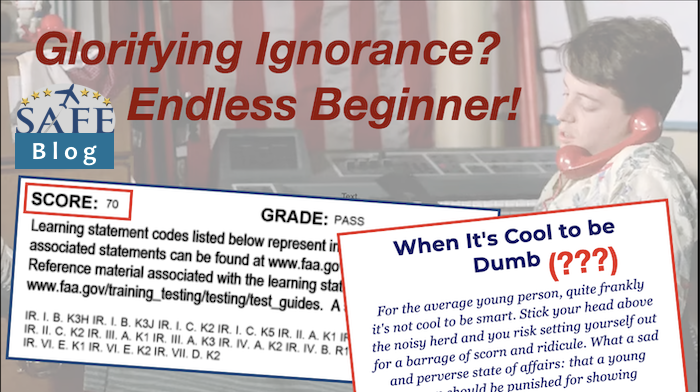
There has always been a certain attraction in our culture to the rule-breaker personality. This is often celebrated in American literature and movies. But when did it also become cool to be dumb?

These traits seem somewhat aligned and also generate an anti-science attitude that seems to be related to “getting by with the minimum effort.” (The 70% scores I see on knowledge tests?) The combination of all these attitudes has been called “slacker cool.”
 Aviation, however, runs on real scientific rules (like gravity). It rewards motivated people who are oriented toward high achievement and have a high regard for “empirical reality” (a respect for science). The laws of nature are non-negotiable and cruel; aviation is physics in motion. What you *want* or *hope* to happen is not important (unless you mistakenly use these emotions to guide your decisions). If a person is not inclined toward the values of hard work, vigilance, respect, and curiosity, they should rethink their career choice in aviation for their own personal safety.
Many of us, when we’re young, feel the pressure to not appear too smart, knowledgeable, or curious, as it leads to social ostracism and being labeled as uncool.
As we move into adulthood, many of those same pressures find us, and we’re quick to repress those same qualities in order to better fit in with those around us.
But it’s those very traits that lead to not only science illiteracy, but the glorification of ignorant, factually untrue positions. Expert-level knowledge is mandatory for a healthy society, and there’s no substitute MORE
 Sometimes called the “tall poppy syndrome,” some people are reluctant to conspicuously work hard (break a sweat) or earn achievements for fear of standing out as exceptional. Instead, they hold back and play stupid.
 This has no place in aviation, nor does the rule-breaker (non-compliance) attitude that leads to rogue pilots. To be successful in aviation, we need people who work hard and are genuinely interested in learning the actual answers and proven techniques. Relying on opinion, hunches, or the often-unwise “wisdom of crowds” (most popular wins) will get you dead quick in aviation. We live and work in an unforgiving environment.
Aviation safety is largely dependent upon the actions and attitudes of the pilot. Consequently, aviation teaches personal responsibility. careful planning, and thoughtful action. If you are a parent who values these traits, aviation is a great activity for your children (even if it doesn’t become a career).
Endless Beginner

The best attitude to approach any new learning challenge is as an “endless beginner.” Because you know nothing, you are not going to look “cool” or “stress-free” or be a “know-it-all.” The most effective learning attitude is to accept a “know nothing” position of total responsibility. (It is OK to be a clueless beginner in a learning environment) Beginner’s mind embraces the struggle and understands this is where learning occurs. By definition, when you begin a new learning project – or even when you get a new temporary – you must be in a state of eagerness to learn and accept input. Accomplishments should be celebrated – this rewards hard work – but self-aggrandizement is obviously inappropriate. But that never happens when you realize there is always more to learn (and that is a good thing). Fly safely out there (and often)!

Join us Feb 23rd for a free webinar on “Succeeding on the Initial CFI Evaluation.” We will have a couple DPEs and talk about common problems and how to avoid them. If time allows, we hope to also add some advice on the “real job” of becoming a truly effective aviation educator. What you learned to acquire that CFI temporary is only half the job; CFI-PRO™ provides the “Missing Manual” of how we really teach.

Tell us what *you* think!