
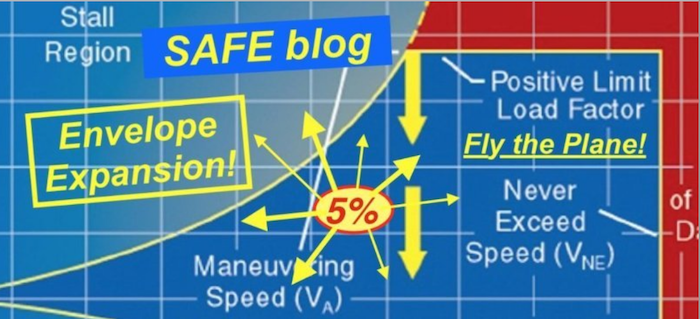
For most long-time CFIs and proficient pilots, “training stalls” often become fairly comfortable, even pedestrian. And for committed aviators, the addition of some upset and aerobatic training further expands understanding and comfort in unusual attitude recoveries. The reasoning behind this approach is to expand the “personal flight envelope” and build “all attitude” control in the aircraft. Rich Stowell’s “Train to Avoid Loss of Control” is a perfect sales pitch for this approach to aviation safety; train to create a surplus of skill in all areas. Embedding stalls in realistic scenarios is especially useful and effective. Please watch this short program:
Unfortunately, this safety formula is not at all common in the general pilot population. The average GA pilot only flies in 5% of the possible flight  envelope. The unfortunate consequence of this “avoidance strategy” is that if these pilots are displaced from their “comfort zone” by weather, mechanical or distraction, they are unprepared for the experience which might cause the familiar startle, panic, and freeze-up. Loss of control (usually leading to a stall/spin) is our #1 fatal accident causal factor.
 The FAA has recently moved to define anything slower that 1.3 as “abnormal” and stalls are defined as an “emergency”. Though both FAA and ICAO have implemented “expanded envelope training” ( for the airlines) this training also avoids any edge of envelope maneuvering. As discussed recently in Flying Magazine, and also in Aviation Safety, the new definition of stalls as “emergencies” seems to discourage practice in this area. The already truncated private pilot flight envelope is getting even smaller through avoidance. On flight tests
  DPEs no longer examine MCA (minimum controlable airspeed) and even the term MCA has entirely disappeared from the Flight Training Handbook. We only transit this (too scary?) flight regime briefly on the way to the full stall (emergency!) and immediate recovery. I can personally attest that pilot skills in this area are already deteriorating as a result of these recent changes. Is the solution to LOC-I to run away from the edges of the flight envelope and perhaps equip every aircraft with a ballistic parachute recovery system?
The drving force behind this change seems to be be the The International Civil Aviation Organization (ICAO). Though advocating for “expanded envelope training”, the Upset Prevention and Recovery Training (UPRT) report, counsels against developing “negative transfer with comfort in the stall regime of flight” by practicing at the edge of the envelope. But many aviation experts disagree, and there seems to be a growing group of experts advocating for all attitude maneuvering and practice as an antidote to the LOC-I problem.
 Extended Envelope Training goes beyond the usual MCA and stalls to include the spiral stalls and “Sixty Nineties” (60 degree banked turns with full aileron reversal every 90 degrees of turn). The beauty of these maneuvers is the ability to perform them in a normal part 23 aircraft (Cessna/Cherokee) without exceeding performance limitations (obviously dual with a competent CFI). I personally use these and other CFI favorites like the “falling leaf” stalls and “rudder boxing” maneuvers to prepare pilots for commercial pilot training. These pilots are often just out of instrument training with 40 hours of “standard rate” gentle IFR control so their maneuver envelope has shrunken even smaller.
The objective of these “envelope expansion” maneuvers is to build greater willingness to “yank and bank” which supplies personal confidence and superior aircraft control. A larger personal flight envelope (also with diverse A/C experience) is a stronger basis for safety than FAA ICAO avoidance– fly safely out there (and often)!
 Enjoy the new courses available to members on the new safe website. And please download and use the (free) SAFE Toolkit App. This contains all the references a working CFI needs plus provides continuously new safety content.
SAFE developed an insurance program just for CFIs! When you are an independent CFI, you are a business (and have legal exposure). This program is the most reasonable but also comprehensive insurance plan you can have (and every agent is a pilot!)


Tell us what *you* think!