
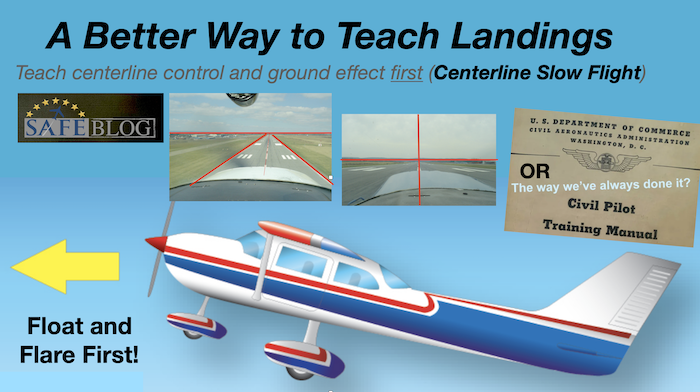
 The most common educational error in aviation is “teaching in final form.” This means inappropriately focusing on a complex skill before a learner has mastered the required component basics (too much, too soon). The impulse for this early focus is laudable; demonstrating progress can build the learner’s motivation. But “too much too soon” creates the opposite: confusion, terror, and disillusionment.
 We see this “teaching in final form” error most commonly with instructional landings introduced in lessons three, four, and five before airspeed control, wind drift, configuration (etc.) are mastered (or even taught). Both the instructor and the learner end up terrified and frustrated with this inappropriate exposure. The training aircraft usually takes a beating as well. There is a simple way to make landing practice more efficient and less scary, but you have to get over the mindless mantra of “the way we have always done it!” (or “the way I learned it”)
 Starting early landing practice is tempting, but a huge mistake. Mastery of slow flight/stall recovery and ground reference (at altitude) are required precursors (with intuitive rudder control) before doing anything in the pattern. Only then can we add the missing components to start landing practice.
Before any landing practice, introduce and master centerline slow flight. This is a slow flight down the runway centerline in ground effect. This introduces flying in close proximity to the runway (which usually terrifies new learners at first) and mastering ground effect (the float and flare). These can be added on return to the airport after every lesson, but without dedicated landing practice. At this point, every pass should terminate in a go-around (build this habit on every landing).
Centerline slow flight is a unique experience that builds on previous experience and teaches many required landing skills. Though slow flight should already have been learned at altitude, slow flight in ground effect is a new experience; the essence of landing. Understanding buoyancy, and controlling pitch and power (with proper rudder control) is a necessary step before landing. Getting the feel for “float and flare” builds new skills; both the kinaesthetic sensations, and the aggressive maintaining of the centerline. Most learners become super motivated when they feel the mastery of this maneuver, and it is a short step to safe landings. Centerline slow flight combines all the skills already taught, with the mastery of runway control. But if these new skills are not mastered at a level of “muscle memory,” landing practice is going to be frustrating, scary, and potentially dangerous. We witness this daily at airports across America: landing too soon.
 In normal traffic pattern practice, exposure to this “float and flare” in ground effect is about 3 seconds for every five-minute pattern (and even more scarce at a busy airport). Grinding out patterns can build instructor hours, but it is largely a waste for the learner. Slow flight all the way down the centerline is a precursor to any landing practice (yes, please let the tower controller know), and teaches the necessary skills efficiently. At 60 knots, centerline slow flight gives 20X more exposure on every pattern (assuming a mile-long runway) to the essential landing skills. This method teaches required component skills rather than introducing landings in their final form. This method extracts the most important new skills and practices them in isolation for maximum efficiency. The final result is rapid progress, with no frustration and half as many practice landings to achieve a confident, safe solo.
 Centerline slow flight also incorporates a go-around into every circuit. A common CFI error is “saving” every bad landing (and their hands are always on the yoke). This teaches the learner to do the same thing: attempt to salvage bad landings when a go-around is appropriate and safer. As learner confidence and control improve in centerline slow flight, reducing a little power allows the wheels to touch in the landing attitude – “hey, we just landed!” What a confidence builder.
Historically, centerline slow flight was a maneuver of last resort that CFIs deployed only for extremely difficult (lost-cause) learners. But this technique is so effective that I have integrated it into *every* instructional project. It is also remarkably effective for improving rated pilots who struggle with bad landings. One word of caution, though: If you are a pilot interested in building skills with this technique, please get some dual before attempting this. Fly safely out there (and often)!
 Next up on the SAFE agenda is our April 12th Webinar on “Checkride Preparation (Endorsements and Experience).” This document will help with preparation.
After that, join us at Sun ‘N Fun in the Alpha Hangar (Booths A61-3). We have FREE wings for members (and *all* CFIs) on Wednesday at noon in the Prop 75 Building. On Saturday ,we host a “CFI Roundtable” 5-6pm (members and *all* CFIs welcome). This is also in the Prop 75 and features FREE ice cream sundaes. Details here.


Tell us what *you* think!