
 One of the common educational errors is “teaching in final form.” We have to practice and master the basic rudimentary skills before attempting the more complex dependent skill. Early Landing is a typical example with learners demonstrating a clear lack of skill in the basics like speed control, ground track, coordination, etc. (Too much, too soon) Often the urge to “prove progress” inspires early landing attempts; creating fear and stress for both the CFI and the learner (while beating up the aircraft).
 In proficiency training also, bad landings are often the focus for necessary improvement. But instead of rectifying the basic problems, many educators attempt improvement by practicing “in final form” – more landings. For both learning and proficiency, the best solution is to deconstruct the complex maneuver into its dependent skills. Deconstructing and practicing the basics leads to immediate transferable improvement in the more complex target skill. (e.g. slow flight at altitude is an excellent tonic to fix bad landings)
In the world of instrument training and proficiency, the analogous complex skill that often needs improvement is the instrument approach. Like landings, when this goes badly during initial training (or proficiency training) the most common “solution” is to do more of the same! (dead wrong). This is the identical CFI error at work, but what is missing in the instrument world are the basic exercises that build skills and control. Most CFII candidates I test have never heard of “light hand” exercises, instrument exclusion, or “Vertical Ss.” (Not tested so not taught)
So here they are; the lost magic that makes excellent instrument approaches. These control exercises along with “Pattern A and B” used to be the first third of all instrument training (followed by nav and approaches, then X-C). Unfortunately, these excellent maneuvers seem to have been lost through “accelerated academy atrophy.” (That whispered message, which becomes completely undecipherable after passing 10 people)
Start With”Light Hand” Flying (Magic Trim)
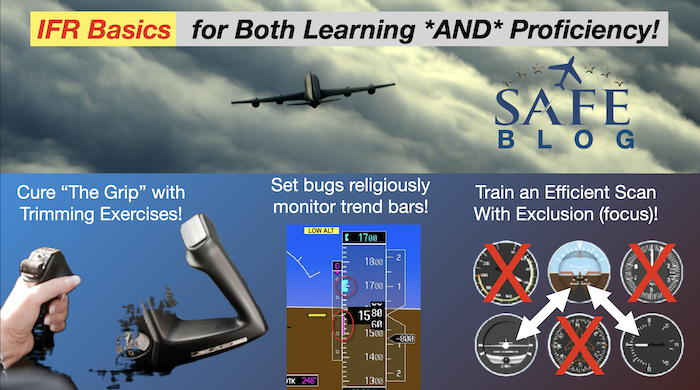
 The first sign of impending problems for any DPE (or CFI) in either VFR or IFR flying is observing a pilot with a “death grip” on the control yoke (or stick). This indicates both a lack of trim and also a lack of confidence in the aircraft to fly on its own (fear). If aircraft control is taking all the pilot’s attention, everything else suffers.
The antidote is demonstrating a well-trimmed airplane to your learner. Have them fold their arms and let the plane fly – “take a few deep breaths and relax!” – the plane does not fall from the sky. This is a demonstration of stability and a confidence builder for a nervous learner. Suddenly, there is a lot more time to accomplish all those essential tasks.
You can take this a bit further once your learner is more confident and relaxed. Put your aircraft in a 30 degree banked turn at a constant altitude. Again, trim (usually two rolls nose up here) and fold your arms. This plane will happily keep turning until it runs out of fuel (lift is equal on the wings). Every attitude or power change your learner makes should be followed by a slight trim and “light hand” verification. The release of the control pressure verifies the correct trim.
Attitude (Change/Check) for Control
 To build (or rebuild) a great instrument scan it is essential to remove the less important gauges (distractions) and put a hot focus on control by attitude. If 80-90% of a VFR pilot’s attention should be outside the airplane, this same amount is necessarily on the attitude indicator (A/I) to get competent control during instrument flight. You have to train (and prove) this to a learner.

So after carefully setting the A/I to level pitch, cover the whole six pack (or analogous glass panel indicators) with post-its leaving only the attitude indicator and VSI. Spend a few minutes flying straight and level then do some standard rate turns (at approach cruise, that is the first “cat’s whisker” on the bottom part of the gauge – where no one ever looks). Once some comfort is gained, vary the power setting up and down slowly. Allow enough time (initially) to allow your learner to adjust the pitch to maintain VSI on zero (and trim). This should be done with a “change” (on the A/I -primary) and a “check” on the VSI. (change/check for everything) The eyes should always be on the A/I when making any change.
After giving enough time to allow the learner to trim off the pressure and “light hand” the controls, pick up the pace as proficiency increases. Try this same exercise in turns too. If you are in your flap range, flaps in and out creates the same challenge. When your learner gets good at this exercise, the plane will be at the same altitude when you uncover the altimeter (magic).
The next exercise is similar but pitches for airspeed by covering everything except the A/I and the airspeed. This should be practiced at a safe altitude because altitude will obviously vary. Starting again at approach cruise ~90K, vary the power (or add and remove flaps) and have your learner pitch to maintain a constant airspeed. Again, enforce the “change,” on the A/I, and “check” on the airspeed. Also initially allow time to trim (and “light hand” the controls), then pick up the pace for more of a challenge.
Vertical S: Magic Skill Builder
The vertical S is much easier to fly than it is to explain. The only good description I could find was in the Gleim’s “Additional Maneuvers” section of their IFR training guide. Start at approach cruise (~90K) in level stable flight. The overview is a 500fpm climb with a simultaneous standard rate turn. With the clock running this should take exactly one minute to achieve both 500 feet of atitude gain and 180 degrees of heading change. This is then reversed and the climb continued in the other direction. After another minute, we are on the initial heading and 1000 feet higher. Do the same in descent at 500 fpm. This builds a great scan, multi-tasking ability, and overall awareness of the trend of the plane synced up with the clock.
 This maneuver really builds a solid “inverted V scan.” Bank to the first “cat’s whisker” on the bottom of the A/I (change), and pitch up 5-7 degrees while adding about 500rpm. Once stable in pitch and bank on the A/I, scan to the turn coordinator (or snakes tongue on glass panel) to verify standard rate. Scan back to the A/I for a small change, then to the VSI and back (“change” only on the A/I) This maneuver builds great instrument pilots. I do these every practice session *before* I do any approaches. Kind of like warming up be fore a run or cycle session. Fly safely out there (and often).
 Join us tomorrow night (Sunday, Sept 14th) at 8pm EDT for a free SAFE Webinar on some of these techniques and tricks combined with a review of an efficient Instrument Proficiency Check.


Tell us what *you* think!