
Every flight test applicant suffers from nervousness at some level, ranging from “butterflies” to “extreme panic.” These all lie along the performance curve illustrated below. Some nervousness is actually good; stress revs up our attention and performance, getting us “off the couch!” Unfortunately, some people get *SO* nervous they can’t perform at all (choke). This same disabling panic can also happen in flight emergencies with the startle response. There are proven techniques to fix this situation that soldiers use in combat.
Human Performance Curve
Think of the diagram below like a performance curve in your airplane handbook. This diagram, however, describes *human* activity graphing performance against stimulation and stress. This is one of the few repeatedly observed phenomena in psychology that has achieved the reliability of an official “Law;” Yerkes-Dodson.
 Beyond an optimal level of performance, different for every person, our performance deteriorates. This is true in every activity, and the right side of this curve is where the startle response lives. In “startle” we are so over-stimulated that we cannot react consciously and correctly. The conscious, intentional brain is out of the circuit. The body assumes control, and the reactions we exhibit at this point are in the “subconscious” realm; automatic. The famous phrase “we sink to the level of our training” is critical here: a human stimulated beyond their “syntonic” level (optimal) reacts with automatic, scripted habits we have embedded from training.
The first step in reducing nervousness (backing down the stress response) is awareness. We need to realize we are in an “over-stimulated” state. People most often fail to do this in anger; they get emotionally hijacked by rage and respond immediately without conscious control, and don’t we always regret this? A common afterthought is “what was I thinking?” And the answer is; we really were not intentionally involved, we were reacting automatically; “emotional hijack!”
In anger or any other form of emotional stress, the best antidote is to pause and consciously slow your breathing. This allows us to take back control! Deep breathing functions as a “system reset,” for the body, like cycling the electrical master in an airplane over-voltage situation. When we pause and take a few deep breaths (called combat breathing for soldiers), it restores conscious control of the subconscious system, which is spinning out of control. Breathing is most typically a subconscious (automatic) activity. By accessing this system and taking conscious control, this tends to reset the sympathetic reaction axis, which is pumping adreneline and cortisol into your body. These hormones create the startle and rage reactions along with a whole series of other survival reactions.
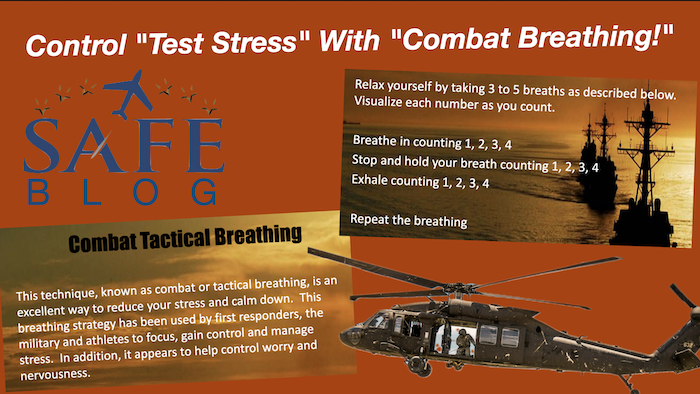
Combat breathing, also known as tactical breathing, is a technique used to manage stress and maintain focus in high-pressure situations. It involves a structured breathing pattern of inhaling, holding, exhaling, and holding again, typically for a count of four, which helps activate the body’s relaxation response.
The military’s tactical breathing technique works by stimulating the parasympathetic nervous system, which helps relax the body. The result is a slower heart rate, lower blood pressure, reduced muscle tension — and a much calmer you.
Combat (Box) Breathing
3-5 slow breaths with a hold on the inhale and exhale is a remarkable tool for calming an over-stimulated situation. Various methods recommend different exact “counts,” but the important part is that we are taking control of a central and automatic bodily function, and this has the result of restoring control of the whole system. Suddenly, we can focus and function again in a more intentional manner. The “emotional hijack” is a whole different b rain/body system going into action. Most people are familiar with this as the fight/flight (sympathetic) response. Your body is taking over from the brain to ensure survival. If we can consciously restore control, a larger spectrum of thoughtful responses are possible. This also points out the dual functioning capabilities we always live with: Thinking Fast (automatic) and Thinking Slow (thoughtful, analytic). Daniel Kahneman won a Nobel Prize for his work in this area of research.
Expanding Awareness – Cooper Code!
 The calming reaction to stress relies on initial awareness of the evolving situation. Without awareness, there will be no preventative action. Every veteran pilot discussing safety always mentions “situational awareness“ as the gold standard for greater safety. Another word for this is “metacognition.” This is a more global awareness, “thinking about thinking:” almost like an angel on your shoulder.” The number one cause of accidents is a failure to perceive risk. Simply increasing our awareness – moving up the performance curve to a greater level of awareness – would reduce accidents greatly. But how we can raise awareness is the burning question.
We fly like we drive, or live our lives; sleepwalking! Try the Cooper Code to consciously raise awareness; a bit more discipline, remembering that flying is a potentially dangerous activity. The awareness that flying can kill you, just like busy intersections and firearms, can bring you out of the left side of the awareness curve and up to Code Yellow. Fly safely (and aware) out there!
 Flight test anxiety is one of the most common obstacles to success during an FAA evaluation. It occurs at every level, from initial PPL to jet type ratings! This webinar will offer solutions based on scientific techniques to quiet those test-day butterflies and ensure a better experience. A calm, confident applicant presents their best performance on flight test day!


Tell us what *you* think!