
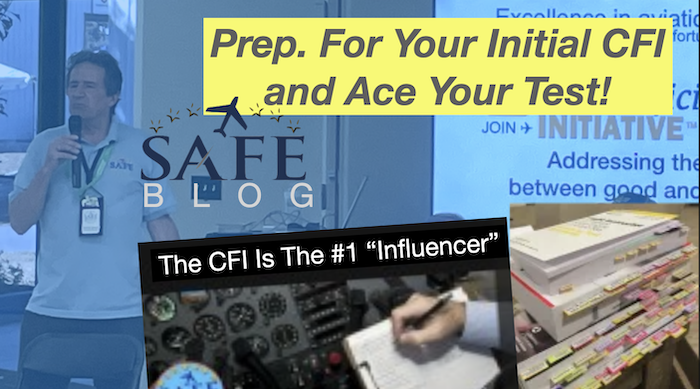
The good news about the initial CFI is that the flight instructor’s initial evaluation is largely a combination of all the knowledge and skills you have already accumulated climbing the ladder to CFI. This is good news if you learned it recently and comprehensively, but this might be bad news if you just “squeaked by”on your previous tests or it was decades ago (more work to get up to speed). The new material for every initial CFI candidate is the Fundamentals of Instruction: “CFI 101.” More on that below.
Your CFI Resource Library: Knowledge

The primary resources for every CFI, especially test applicants, are the FAA handbooks. Most pilots never saw these during their initial training; instead, they used “secondary sources” online or from other manufacturers. To succeed on this checkride, every applicant must gather these FAA “primary sources” and learn them well. They are also essential resources during the test. Except for the Flight Instructor’s Handbook, you can refer to all the handbooks during the CFI evaluation. You will use these even more when you become a working instructor because every DPEs must follow this specific FAA Guidance to the letter; “the final word!” Secondary sources, from many manufacturers (and even YouTubes) are sometimes helpful, but the FAA Handbooks provide the official FAA policy. There is a list of all these resources in the current CFI ACS. This also includes a current FAR/AIM, a pile of Advisory Circulars, and the current ACSs for Private and Commercial Pilot; this is what you are “building” as an aviation educator.

So step one for an Initial CFI applicant is building their CFI library and familiarizing themselves with the material from Private and Commercial at an educator level of understanding. Handbook resources are available for reference during a CFI evaluation, but you need to demonstrate fluid access of the material – not an “Easter Egg hunt!”
You also need a current FAR/AIM, either from ASA in paper or digitally as an App (ASA provides a generous 20% discount to SAFE members and SPorty’s has some “combo deals” for the CFI) FAA Handbooks are also contained on ForeFlight in “docs” with a simple tap to download. ASA’s digital FAR/
AIM is easily searchable and updates automatically with every change,. This app also has a list or regs at each certificate and rating level.
It goes without saying that as an educator, you need to demonstrate mastery of all this material since you are teaching it. Most applicants preparing for the initial CFI are shocked at how much they really *didn’t* originally know when passing each pilot evaluation. Go through the private, commercial, and CFI ACSs and make a list of all the reference documents. Then look at all the required knowledge items and highlight them and look them up the FASA references for each.
Fundamentals of Instruction
 The Fundamentals of Instruction is the brand new material for the CFI evaluation. Remember the CFI is not a rating on your pilot certificate, it is an entirely new and different certificate. You are learning to be an “effective educator.” This requires an entirely different set of skills and personality from the normal pilot. The pilot personality is typically confident, emotionally cold, suspicious, and even a little paranoid. Often pilots are a bit impatient and goal-oriented: see this profile. (And for fun, take this personality quiz and you might be surprised how well it fits).
By contrast, any successful CFI has to possess a good deal of emotional intelligence to be successful. The contrasting personality profile for an educator is HERE. (See also this *required* Area of Operation I, Task E) These qualities of communication and caring, patience and empathy are what make educators effective. This is very different from pilot personality qualities: “The Hard Truth About Soft Skills” Remember this as you study the FOI. This is an entirely different world from just piloting the plane. Your new job is *educating.*

 The FOI is very much the bare minimum of knowledge to be a successful educator; CFI 101. That is why they call it “fundamentals.” I recommend a much better book for professional CFIs who stay and flourish in the CFI business. All the techniques and concepts in the Aviation Instructor’s Handbook must be internalized to become an effective educator. Think now you habituated the use of the right rudder to become a pilot. The use of that control to cancel yaw is now subconscious and automatic To be successful as an educator, you need to read FAA H-8083-9B thoroughly and internalize those educational concepts, definitions, and components. These are the basic tools.
Create Flash Cards For Common FOI Concepts

My recommended learning technique for the FOI is to read the relevant parts referenced in the CFI ACS, find the references in the Instructors Handbook, and create flash cards for every important term: “learning, motivation, communication, etc). Then you can review and memorize them. This is hs. Just like your lesson plans, the creation of these tools is part of the learning process so I suggest

As an example: Write “Learning” on an index card, and then copy and write the complete (boilerplate) definition from the handbook: “a change in behavior as a result of experience.” Next write the items that comprise this concept (page 3-9 of CFI Handbook): “Purposeful, Result of Experience, Multifaceted, and An Active Process.” When you are asked during the evaluation to to explain what learning is, you will not just parrot this but rather use it as a framework to craft an intelligent reply. You will be mentally prepared and include all the key concepts in a more eloquent and expressive response (it works)l
 It is very helpful to use acronyms to remember any group of items, but please keep these to yourself in any evaluation (Or when working with a learner). Applicants who just spout “TOMATOFLAMES” to an examiner and then forget what that means, are only demonstrating their ignorance. Your acronyms should be an internal scaffolding on which an applicant builds your more cogent and comprehensive answer.
Practicing your verbal delivery and “professional presence”is probably the most important part of your whole preparation for the initial CFI. When an applicant walks into an evaluation confident and prepared looking and acting like a flight instructor, they are halfway to the goal. I recommend you record yourself presenting your lessons and critique your own performance as an educator. Remember, your words are your primary tools as an educator. To be successful in your communication, you must be organized and expressive; essentially a good public speaker. This is a skill to practice and master.
Once you have the framework of each concept mastered and memorized, it is essential to dig deeper and elaborate on this framework. It is essential to ask yourself and resolve “the why!”: “Why is this concept important to you as an educator” (the DPE will endlessly ask “the why”). Rehearse and record your answer. If it regards the characteristics of learning, your answer might include: “Learning is active and continuous. The learner is ‘always’ on input, not just when we are actively ‘teaching.’ They watch and learn from YouTubes too – importing crazy ideas we do not even want them to absorb. As an adult learner, they come to us with a ‘naive rendition’ of how they ‘think’ airplanes fly (often incorrect) which we must overwrite with new knowledge.”
DPEs are not looking for a rote answer like on your index card memory game, they are mandated to get to a correlative level of understanding and presentation. A successful applicant has to take those basics and expand them into a meaningful presentation! The important guidance on this is not in the ACS (or even in the CFI Handbook), but is in the “ACS Companion Guide for Pilots” on page 9. This is a new reference that came out with the CFI ACS in June of last year.
Instructional knowledge means the instructor applicant can effectively present the what, how, and why involved with the task elements using techniques described in the fundamentals of instructing (FOI) area of operation in an instructor ACS.
It is important to understand what”instructional knowledge” is and demonstrate it continuously. This is not just “knowing,” but “presenting” any topic in a fully formed, cogent, and attractive manner. To do this comfortably as a true professional, you need to “Build Your Pilot!” Only through this personal preparation will you be able to walk in with that kind of “in charge” attitude; master of the material.
“Build Your Pilot!”
This preparation puts all your studying and collection of FAA guidance together as you start with lesson one of private pilot and create lesson plans to take this person all the way through commercial certification. This assembles all the materials and your work here burns this material into your “CFI operating system.” This is where buying a pre-packaged “CFI in a Box” kit is not too useful. Unless you invest the time and effort and create this yourself, it will not be fluidly available for you as a professional educator. The ancient Ed Quinlan flight plan book is a good guide to see the structure and content (but update all the data). Start with all the CFR 61.87 (solo) knowledge and skills and add the CFR 61.93 (cross-country) items. These are the core items for any CFI. Learn the required experience and endorsements and carry this through checkride preparation. Remarkably, 1/5th of pilots recommended for flight tests are not qualified in some manner. Do the same for the commercial pilot and make sure to look at the CFI NOTAMs of common CFI mistakes (especially at the commercial level). Read and review the common FAA Letters of Interpretation and weak areas on CFI Flight Tests.
Systems and Your Airplane
You want an information manual for the plane you will be flying and read it thoroughly. Know the standard POH layout (GLENPWAS- and be able to teach it) and especially make sure you read the “amplified procedures” for each operation (this reveals “the why” of each action you are performing). When you know “the why” you will be teaching with meaning. (Common DPE question: Explain why do we turn the master switch off and on for an electical emergency?) Have an accurate checklist that agrees with the POH for your checkride (and use it).

You will probably you will get a X-C flight to teach, including all the performance calculations and weather considerations. Teaching risk management will be a very important part of success here. (read thoroughly the Appendices in the CFI ACS). Know your P-A-V-E and how to apply this to your operation during all phases of flight. This exercise gives an examiner many opportunities to explore everything from airspace to hypothetical emergencies. Verify that your checklist conforms to the POH especially in the emergency section. I see a lot of “A-B-C-D-E checklists” for emergency operations and I have *never* seen that in a POH. Be aware of what “immediate action items” are (the emergency flow from the manufacturer required to be memorized). This will be valuable for all pilots that intend to upgrade into turbine equipment (professional piloting).
Legal Plane/Legal Pilot/Airspace/Weather
 This is a common weak area (along with systems) for all initial CFI candidates. The basic 91.205 requirements and how to legally alter a plane with broken equipment per 91.213(d). This goes hand in hand with the systems and that is how it should be taught. “The airspeed is unreliable, what other instruments might also be giving erroneous data?” All this is information covered on the Private and Commercial a CFI candidate has already passed, but DPEs often discover serious “black holes” in learning. This list is from the ORlando FSDO from the 90s and still is valuable today: “Common Weak Areas on The Initial CFI.” If fact, this list could in most cases apply to the majority of pilots.
Endorsements, CFI Privileges and Limitations
 “Endorsements and Logbook Entries” is another *required* task in the FAA CFI ACS; Area of Operation II, Task K. This is largely guided by AC 61.65 (currently J model). This little AC is the bible here for educators. The power of the CFI pen is mighty. With an hour of ground and an hour of flight you can turn a person who has not flown in 20 years back into a pilot (the flight review). You will be required to explain all the endorsements starting with how you create a student pilot cert. in IACRA (very little good FAA guidance here) to the 15 items in 61.87 (solo) and the 61.93 requirements for X-C and the requirements to endorse a private pilot for a flight test (1/5 of tests fail to legally qualify). Ever test applicant (and working) CFI must know these and be familiar with sensible limitations that demonstrate good CFI risk management.
Step outside the obvious endorsements and figure out how to endorse a pilot of another category (helicopter) to solo in an airplane (not 61.87). Also dig into the regs to determine what training are required for a Commercial helicopter pilot to add a fixed-wing multi-comm to their certificate (a common military conversion). These are the “edge cases” DPEs love to dig into.
 Flight reviews (as mentioned above) are also huge responsibility that every applicant must respect and be familiar with (this is probably the biggest “safety gap” in our flight training system). The FAA has specific guidance for most of these tasks (search engines are a great tool). Here is a list of risk-management concerns for every CFI to watch and teach during flight education. Fly safely out there (and often)!

Join us this Sunday for a free webinar on these same topics with a couple DPEs on board to discuss common problems and how to avoid them. If time allows, we hope to also add some advice on the “real job” of becoming a truly effective aviation educator. What you learned to acquire that CFI temporary is only half the job; CFI-PRO™ provides the “Missing Manual” of how we really teach. 
Tell us what *you* think!