
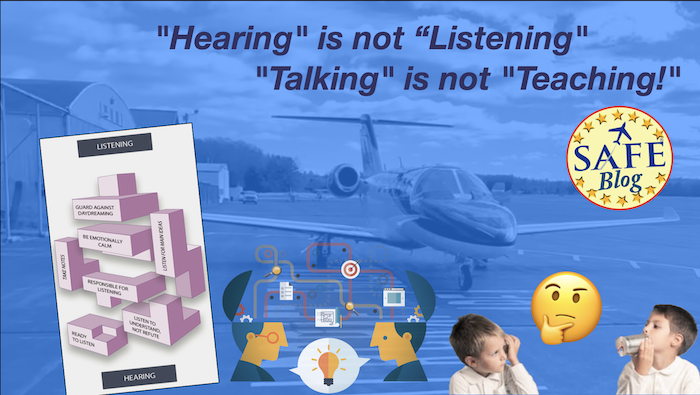
There is some great wisdom in the FAA Aviation Instructor's Handbook regarding "communication."
 In our busy, buzzing world we seldom actually communicate effectively. Instead, we often just “talk at each other” – talking in both directions, but no one is “listening!” This is also why “teaching” most often fails.
 I was just reading and replying to the comments on our (very busy) SAFE YouTube channel. The replies here are typically very binary (love/hate) and “shot from the hip.” They are seldom thoughtful (a symptom of our polarized politics?) Very few people take the time and effort to suspend judgment – to “reflect and consider” – before replying in writing. Another associated characteristic is the overbearing pilot ego; “I have more than 300 hours in a plane dude.” Establishing credibility through experience and social standing is a power move. Unfortunately, hours are no assurance of intelligence; just certitude – not correct information.
 Effective communication requires that “magic pause between action and reaction” where we reflect and consider. This moment is what enables effective education. In our typical hurry, or when we are protecting our ego, we frequently just “talk at” instead of “engage and teach!” Successful education requires a trusted “learning zone” to make communication possible. This requires both a physically quiet environment, but also an agreement of trust and honesty. Education is a partnership that requires caring.
 The “airplane classroom” is the usual example of distraction in aviation. But distraction can be even worse in a busy flight school environment. Our buzzing world of digital distractions often provides an experience rivaling airborne interference. Communication is a very intentional skill that must be practiced and carefully deployed to achieve effective education. It also requires some time to ponder the input, reflect on the message, and formulate a meaningful reply. This must be in context and valuable to the listener to be received.
 The listener’s input channel must also be available (not formulating a reply or an excuse). Accepting responsibility is a critical component of effective learning in every educational environment. A learner has to feel trusted and safe so that excuses are not necessary. Excuses deflect responsibility to protect the ego – “not me!” Accepting our ineptitude is crucial to moving forward in skill and
  knowledge. Since every “learner” is in a totally new environment (by definition), “clueless” is expected in education. Saying “I do not know, teach me!” is a totally acceptable – and necessary – psychological posture to embrace (beginner’s mind). The “know-it-all” usually makes no progress because they do not accept input from the educator (teachability index).

The FAA CFI FOI provides a brief “Psychology 101” for pilots transitioning to educators. The “pilot personality” is often an obstacle to overcome, but it ultimately teaches more effective CRM for future missions. Fly safely out there (and often)!

 Attend our Multi-Engine Webinar with Hobie Tomlinson Dec.15th at 8pm EST. This provides FAA WINGS credit.
Join SAFE and get great benefits. Enjoy 1/3 off ForeFlight (more than pays your annual dues) and your membership supports our mission of increasing aviation safety by promoting excellence in education. Our FREE SAFE Toolkit App puts required pilot endorsements and experience requirements right on your smartphone and facilitates CFI+DPE teamwork. Our newly reformulated Mentoring Program is open to every CFI (and those working on the rating) Join our new Mentoring FaceBook Group.
Tell us what *you* think!