dvis3yzawwgr9p4du4g7rcqsie1vi7

Antidote For LOC-I: “Full Control Maneuvering!”

Published on

in

When I got my flight instructor certificate, I decided to extend my flight envelope with some aerobatic training. I had been to the  Sussex Air Show numerous times and loved watching Leo Loudenslager, Bob Hoover, and especially The French Connection. Their aerobatic school was nearby so I booked some time in their program (there was no formalized “upset training” at the time).

I had flown small light tailwheel aircraft, but nothing like the Cap 10 they flew at their aerobatic school. Cinched tightly into an exotic tailwheel with a parachute doing inverted “dutch rolls” was interesting but not building the skills I could apply to my world of flying. This was way beyond my personal level of skill and foreign to my flight environment; an expensive amusement park ride! I decided to approach this project in smaller steps at my local airport in my familiar normal category airplane:  Extended Envelope was born.

Step one, required building a better theoretical framework of basic aerodynamics and control. Amazingly, you can learn to fly (and even teach legally) with the basic level of aerodynamics in the FAA handbooks. They do pretty well with the basics, but it is essential to move beyond the “starter kit,” and commit to a little “grad school!” AOPA’s Focused Flight Review is a good resource to start this project. The best book to initially extend your understanding of flight in three dimensions is Rich Stowell’s Emergency Maneuver Training. For aerodynamics, try Bill Kershner’s Advanced Pilot’s Flight Manual

To expand my flight envelope, my mentor, Stick, was more than happy to incrementally build new skills with “steeper turns, 60/90s, and turning stalls with ballistic recoveries.” I discovered a C-152 Cessna Aerobat locally that was almost identical to what I was teaching in. Finding a capable “all attitude capable CFI” locally is increasingly difficult. The maneuvers that became the core of the “Extended Envelope Training” are just “old school flight training.” This is increasingly rare in our modern world of “accelerated training minimums.

I still use these maneuvers to tune up my instrument pilots when they are ready to start commercial training. After 40-50 hours of IFR training, they were only capable of smooth trimmed turns with gentle banks; eyes totally on the gauges. To be safe pilots we must stay current and comfortable in many different flight regimes. Extensive IFR and automation builds bad habits for the serious VFR pilot. The flight maneuver envelope shrinks dramatically with the eyes *inside* and timid control usage. EET forces the  “eyes outside and yank and bank!”

The original Upset Prevention and Recovery Training (UPRT) was directed at transport category aircraft and flight crews who were suffering from this increasingly smaller flight envelope of capability and confidence. This is a well-known problem due to automation dependency. In the airline and corporate world, only 3% of flight time is “hand flying.” It is easy to get rusty. The FAA mandated Extended Envelope Training for the airlines in 2017: AC-120-111

Continuous use of autoflight systems could lead to degradation of the pilot’s manual handling skills and ability to recover the aircraft from an upset. As manual handling errors have been increasing, operators and authorities have recognized that operators need to enhance the manual flying skills of flight crews. MORE


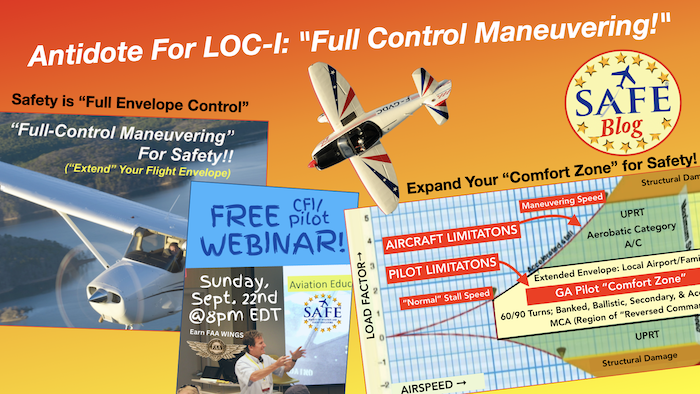
Visualize the flight maneuver envelope as a continuum with the usual pilot flying comfortably in a very small 7-10% envelope. This would be 1.5 positive G limit, with even a 45 degree bank considered “extreme.”  Most pilots have not done a power-on stall in years. Unfortunately, this is where 90% of fatal pattern stalls occur. Living in this smaller envelope of confidence and control is not safe. This is why Loss of Control-Inflight is the number one fatal accident cause.

Surprise displacement from the “comfort zone” can occur with weather, wake turbulence, or ATC surprises and a pilot is suddenly in “startle!” We react to sudden displacement with very slow/poor reaction times or even lock up. When I flew a UPRT flight at Patty Wagstaff’s School it became immediately apparent that for a well-trained (3D) pilot there are no “unusual attitudes!” The classic “Public Service Announcement” by Rich Stowell clearly lays out the need for “full control maneuvering” in all three dimensions.

This video, of course, illustrates a full Upset Prevention and Recovery Course (UPRT), which is very valuable. This does, however,  require a fully aerobatic aircraft, parachutes, and additional resources for time and travel. My suggestion is to start locally with a familiar airplane first flying extended envelope maneuvers with a competent CFI. Get your basic VFR eyes outside/rudder skills up to speed. Then by all means go push the envelope a little further with a full UPRT course. We will explore this world of “full control maneuvering” in our Sept 22 webinar. The FAA approved Master FAA WINGS credit for this event. Fly safely out there (and often)!


See “SAFE SOCIAL WALL” For more Resources

Join SAFE and get great benefits. You get 1/3 off ForeFlight and your membership supports our mission of increasing aviation safety by promoting excellence in education.  Our FREE SAFE Toolkit App puts required pilot endorsements and experience requirements right on your smartphone and facilitates CFI+DPE teamwork. Our newly reformulated Mentoring Program is open to every CFI (and those working on the rating) Join our new Mentoring FaceBook Group.

9 responses to “Antidote For LOC-I: “Full Control Maneuvering!””

  1. Warren Webb Jr Avatar
    Warren Webb Jr

    While I got into aerobatics shortly after getting my PVT (our club got a Citabria and one of our instructors just happened to own a Pitts and competed in aerobatics), it wasn’t necessarily because I felt my basic skills were weak or limited – they weren’t. It was for fun. Yes it gave me more skills, but they didn’t change the way I maneuvered in the pattern, or performed approaches and landings.

    Pilots do lose safe control when they over-react. Two examples that I always remember is the Cirrus that turned base too early at Melbourne, FL, and then lost control when he tried to abruptly turn back to the downwind. The other case is Air France 447 – the co-pilot held the pitch at 35 degrees. I see the need here is to know more about how to move from one attitude to another while staying within the flight envelop rather how to recover from having moved outside of the flight envelop. This can be incorporated into basic training – for example turning base too early is a common mistake. In safe conditions, practice making that error – then how to recover.

    The biggest statistic is the one with landings. During landings the pilot must be able to clearly see what is happening – i.e. the trajectory, height above runway, attitude, drift, so forth. The FAA says one of the worst things a pilot can do is to look too far down the runway – “If the pilot focuses too far ahead, accuracy in judging the closeness of the ground is lost and the consequent reaction is too slow, since there does not appear to be a necessity for action. This sometimes results in the airplane flying into the ground nose first.” Does that sound like familiar issues? A car on the highway is in the same speed range as a small airplane landing – when you are driving on the highway, do you look 3000ft ahead? I doubt it. Yet close to 100% of the time, the articles and videos I see on landings recommends shifting your vision to the end of the runway. Bottom line I think the resolution to solving LOC is a better look at the fundamentals.

  2. David St. George Avatar
    David St. George

    After years of teaching landings, I am convinced 90% of success here is getting the correct visual cues and reacting appropriately. If people stare at the “aim point” they inevitably level high…looking too long they *do* fail to “break the glide!” I recommend a near and far scan to find the level off and once level in ground effect, look distant to judge the flare accurately. Rod Machado’s “Runway Expansion Effect” has helped many of my students. No one gets enough time in those last 5-7 seconds of the landing…watch this video: https://www.youtube.com/watch?v=Rv5HEJCyTuk

    1. Warren Webb Jr Avatar
      Warren Webb Jr

      I recently was introduced to that technique in another video a year or two back. I was taught straight from the Handbook and I’ve taught the same way. I’ve had a number of students who were greasing some of their landings even before they soloed. I’ve had a LOT of landings like that (including in models much bigger than trainers) and a number that were 100% not even felt. So, that seems to mean that the FAA’s recommendations are not bad.

      I have several problems with Rod’s technique. He says ‘it works in most instances in smaller airplanes’. That’s a big red flag. Most instances? What does that mean when it doesn’t work? Is he talking about an incident or accident? Seriously, I believe any technique, literally any technique, should always work and in all airplanes. How could a CFI teach a technique that sort of works in a 150, but then as that student is working into a professional career and flying larger higher aircraft, it doesn’t work? He said it assumes Vref speed. Once I came in with a load of ice so I did the recommended thing and maintained extra speed on final to a long runway. It was a long float of course but I had no problem with the whole process. Rod’s way would have left me in a vacuum. Rod – raise the nose to level. That’s going to produce inconsistent results because the nose may be brought to level too quickly or too slowly and there’s a difference in airplane performance. I can imagine ballooning in many cases. In other cases, too much energy lost and a hard landing. The MAIN factors to control with the elevator in the roundout are the altitude and rate of descent. That’s what gets the mains just above the surface at near zero rate of descent for great landings in all airplanes 100% of the time. Rod – put the top of the cowling on the distant horizon as you settle. Again this doesn’t transfer between airplanes because of the shape of the nose cowling, and in some cases, there is no horizon to see. And last but not least, what is a pilot to do if there’s a landing on a turf runway with no edge references, or making an emergency landing off airport? Rod’s technique is no help. You just can’t leave pilots in a lurch like that.

      1. David St. George Avatar
        David St. George

        I think we agree on this. In the last part of the landing you must be looking to the end of the runway to assure alignment while setting the landing picture? Look distant: “Rod – put the top of the cowling on the distant horizon as you settle.”

    2. Warren Webb Jr Avatar
      Warren Webb Jr

      On the approach the focal point is primarily the aiming point. Nearing the aiming point, the focal point starts moving down the runway. At 10-20ft above where the flare is started, I’m looking generally about 4 centerline stripes ahead. As the airplane nears the runway surface, that focal point comes gradually closer to the airplane reaching about 2 centerline stripes at touchdown because I’m keeping the same slightly downward viewing angle as recommended by the Handbook. On an annual 141 standardization with another instructor who I thought landed better than anyone else, we happened to get into a discussion about the pilot’s vision on landings, and he said he was looking at exactly the same place.

      David – I don’t understand how your procedure to look distant is going to work for someone who learned that for the PVT, and now for the Instrument, he/she will be landing with possibly 1800ft rvr. This is for sure something on which the pilot depended from day one and now it’s gone.

  3. Chris Papageorgiou Avatar
    Chris Papageorgiou

    Great advice for confidence building and life saving skills acquisition plus learning how to really enjoy flying.
    Basic Acro is fun, time and money well invested.
    Fly safe.

  4. brianlloydaero Avatar

    Good evening David. Another good posting, thank you.

    I am just back from a day of teaching UPRT. Ground school up-front and then three students in the plane in the afternoon.

    I chuckled when I saw your Vn diagram with the “GA Pilot Comfort Zone”. I have the same diagram but it is the pdf of my POH for my airplane with me having “drawn” on it with the mouse to say pretty much the same thing.

    Interestingly enough, I am starting to get primary students and low-time PPSELs coming to me saying, “I don’t think my instructor is teaching/taught me enough. I have heard good things about your program. Does it make sense for a low time pilot like me to come fly with you?” Of course, the answer is ‘yes’. The biggest thing I find is that most pilots and CFIs have only the vaguest notion of how airplanes fly, how their flight controls work, and how lift and energy pull it all together. It is no wonder why, when things turn bad, they do the wrong thing.

    As for your comments on landing, I think you are spot on David. One other thing that I emphasize is learning airspeed control and then selecting the correct airspeed for the final approach. I don’t take my primary students to the runway for pattern work until they understand the relationship between energy of altitude, energy of speed, power, and how to move between all three to end up with the correct energy solution, i.e. arrive at the runway at the right height and airspeed. Most CFIs teach their students to carry too much airspeed and that makes landing difficult. If done right, you make that final turn from the descent flight-path, to parallel-to-the-runway, and the airplane runs out of energy right there. The airplane is on the mains and not prone to bouncing, floating, ballooning, etc. No, they are not “greasers” but the are consistent, good, safe landings where the airplane touches down and stays down.

    Anyway, another good message. I hope others are listening.

  5. Warren Webb Jr Avatar
    Warren Webb Jr

    “I think we agree on this. In the last part of the landing you must be looking to the end of the runway to assure alignment while setting the landing picture? Look distant: “Rod – put the top of the cowling on the distant horizon as you settle.””

    There was no reply button for your comment above. David – no. This is where we have the maximum disagreement. Visually I keep a slightly downward angle like the Handbook recommends. It is the natural point ahead where the details are in the sharpest focus. Closer is out of focus from movement of the airplane – further down the runway is less and less in focus as the distance increases (ref: fig 9-8 Airplane Flying Handbook). It should be a consistent distance to get a consistent estimation of the airplane’s position, not 2000ft ahead for one landing, and then 4000ft ahead for another landing on a longer runway. Some runways are over two miles long, like 31L at JFK (14,511ft) which is where a small airplane will land to go to the FBO (been there more than once). Only superman would be able to see the end of that runway. Relying on the cowling doesn’t work either. Some models (LSA, Baron – there are many others) have an engine cowling that slopes down and may not even be visible when landing, so learning and relying on that technique in a C150 will likely leave the pilot with no reference point in some other aircraft.

  6. […] we could be teaching some basic UPRT or the SAFE EET curriculum to address our #1 pilot killer: Loss of Control. (maybe a tailwheel endorsement?)  Any of these curricula would expand the pilot’s […]

Tell us what *you* think!

This site uses Akismet to reduce spam. Learn how your comment data is processed.


Thanks for Visiting!

Thank you for visiting the SAFE Blog. There are over 500 specifically tailored articles covering a wide range of aviation issues related to flight training both as a pilot and as a CFI. Search HERE for a specific article, and Join SAFE

Please try our new AI Tool (Chat 5.2 trained on SAFE Blog content) for your specific topics of answers to your aviation questions. SAFE crafted AI Tool


Notification Here!

Stay updated with our latest tips and other news by joining our newsletter.


Free SAFE Toolkit App

Everything a busy CFI needs at their fingertips, *plus* resources for pilot applicants: “Checkride Ready” (with all the DPE advice on how to pass your practical test) FREE Download

Discover more from Aviation Ideas and Discussion!

Subscribe now to keep reading and get access to the full archive.

Continue reading