
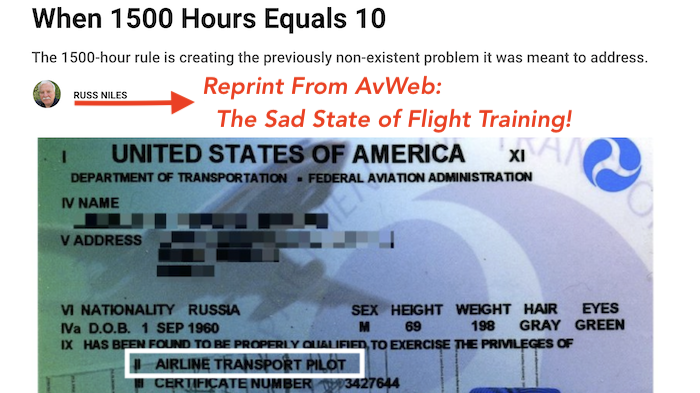
Reprinted from this AvWeb Report from Oshkosh: Russ Niles Reporting!
Russ Niles Takeaway from OSH on Flight Training!
“What I didn’t expect was [Doug] Stewart’s bone chilling assessment of the state of flight training and the terrible prognosis for the professionalism of the industry. In a nutshell, the 1500-hour rule has resulted in a generation of ATPs who have only the vaguest idea how to fly any airplane, much less a 100,000-pound jet.
I actually had a tipoff to this going into the interview. I made the acquaintance of one of those people who make you question all your life choices. He’s a 737 captain in his mid-30s who’s accomplished more in aviation than any 10 pilots I know. His frank assessment? When he gets a new hire on his right side he assumes he’s flying as a single pilot.
So I hit Stewart with that with my first question and to say he ran with it would be an understatement. After decades as an instructor, he says he’s never seen such unmotivated, unskilled and generally clueless students on their way to the airlines. There are some exceptions, for sure, but in general the vaunted ramp-up of flight training might as well be pumping air into the right seats of the nation and it has him terrified.
He puts the blame squarely on the 1500-hour rule that was ordered by Congress after an accident in Buffalo, New York, that killed everyone on a Colgan Air Dash-8 Q400. The new law was supposed to have ensured that anyone with an ATP has the experience under his or her belt to competently fly big iron. In fact, it has led to a situation where one of those 1500-hour wonders can reach that all-important milestone with only 10 hours of solo flight time.
Huh?
Here’s how it works. Fresh-faced pilot wannabe shows up for a discovery flight and decides a life in the clouds is for them. Ground school and those beautiful, scary, challenging and profoundly rewarding first few hours when they realize that they can actually maneuver this great clattering mechanism in the sky follow. They actually start getting pretty good at all aspects of flight but there always seems to be something they’re not doing quite right, and 20 hours turns into 30 or 40 or more and they haven’t actually gone solo.
Now, in fairness, things have changed since I lifted that ancient 152 off the runway at Vernon Regional Airport with 12.5 hours of dual in my logbook while my instructor watched from the ramp. I flew the perfect circuit (Canadian for pattern) and floated slightly with a little skip before settling on Runway 23, and like you I remember every second of it. Today, that would be an extraordinarily early first solo because airspace is more complicated, the panel takes longer to learn and the rules are more complicated. But I know a bright kid who’s at 40 hours and hasn’t felt that joy. I talked to a guy at AirVenture that went 72 hours.
How the hell can this happen? Well, the person in the right seat has no interest in having that magic moment occur. The only way they can possibly afford to rack up 1500 hours is to instruct and that career Hobbs stops moving as soon as they are left on the ramp. Then it slows to a crawl while the student bores holes in the sky and learns the hard way about this three-dimensional environment that is so unforgiving. It’s an inescapable rite of passage and it’s an experience I rank as one of the most powerful in my life.
So, the goal of the instructor becomes getting back in that plane as fast as possible and the 10 hours it takes for students to accomplish the solo tasks in the syllabus becomes the maximum amount of solo time permitted. What follows is rote memorization of maps and emergency procedures and all the other stuff we need to know before our certification ride. Since that event is highly prescriptive, there’s not much chance for the DPE to assess whether the candidate can fly, just whether they can pass the exam.
Assuming our student is on the airline track, the process repeats itself with them infecting dozens of future airline pilots with this terribly flawed notion of what it is to be a pilot. It’s also resulted in massively profitable flight-training centers that are openly described as “puppy mills.”
One would assume that after thousands of hours of watching incipient pilots demonstrate new ways to kill themselves and him that Stewart would have some perspective on the situation, but he’s clearly terrified and now so am I.
Congress’s politically tuned fix for a nonexistent problem has led to a crisis with far greater risks than it was intended to fix, and it needs to be brought to their attention and fast.”

See “SAFE SOCIAL WALL” For more Resources
 Join SAFE and get great benefits. You get 1/3 off ForeFlight and your membership supports our mission of increasing aviation safety by promoting excellence in education. Our FREE SAFE Toolkit App puts required pilot endorsements and experience requirements right on your smartphone and facilitates CFI+DPE teamwork. Our newly reformulated Mentoring Program is open to every CFI (and those working on the rating) Join our new Mentoring FaceBook Group.


Tell us what *you* think!