
 A recent Instagram poll on “cross-control” again revealed a persistent ignorance of slip/skid aerodynamics among all respondents. I see ignorance in this area continually on flight tests and most applicants are surprised when I tell them we will slip all the way to a landing (“My flight instructor never showed me this!”) The ACS clearly specifies “Slip to Landing” and sets a touchdown accuracy standard as well. (Our Aug. 11th Webinar is on Cross-control). It is bad enough that we never test a crosswind landing (not required) but when we skip a required task, that is an illegal flight test.
Obviously, the minimal FAA standards are getting “increasingly minimal” with the crowded testing schedule. The average PPL evaluation is currently running only 1.3 flight hours. I regularly see 2-3 landing logged and .1 simulated IFR when performing follow-on tests. If we do not test all areas of operation and tasks, the CFIs and schools will not teach these s. The DPE is the gatekeeper and determines the training quality by maintaining the testing quality.
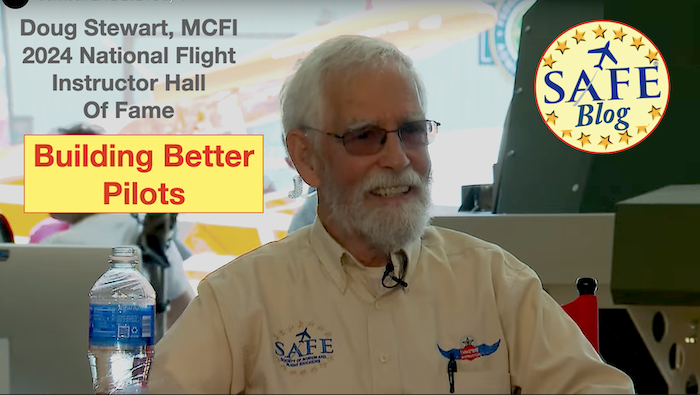
Congratulations Doug Stewart: National Honor!
 Doug was very deservedly inducted into the National Flight Instructor Hall of Fame at Airventure; Congratulations 🎉! He also reiterated the declining level of flight proficiency among pilot applicants during an interview on “Oshkosh Live.” Currently, the private pilot evaluation has the highest failure rate of all FAA tests – even exceeding initial CFI. The industry is obviously failing in its preparation of new pilot candidates – lots of empty promises and “hurry up, minimal standards.” These minimal standards continue right up through initial CFI – “faster and easier” is the gold standard – providing only 10 hours of real solo time and rote-level educator preparation!
The Solution: SAFE CFI-PRO™
I think we are all familiar with the problems in the current flight training environment. The solution can only come from improving our new aviation educators. As long as we have “babies teaching babies” there will be a descending spiral of proficiency and professionalism. I am sorry this sounds insulting (we all started there), but there has to be an attitude of humility and curiosity in these new educators with a willingness to learn and grow (this is a student-teacher certification). We need to inject professionalism and experienced mentoring into the educational process.
A “wet FAA temporary” CFI certificate holder is not prepared to teach the next generation of pilots (especially now with PDPIC standards of 10 hours of real solo).
SAFE CFI-PRO™ was derived from an FAA program that reduced flight training accidents by 60% in just two years. This program was created in the early 1990s when when CFIs were going to the airlines with only 250-300 hours total time! All new CFIs need to access this “missing manual” of tools and techniques to accelerate their “on-the-job” training. Our continuing webinar series is next live on August 11th: Fly safely out there (and often)!
 Register and attend our August 11th Webinar on “Learning Rudder and Cross-Coordination.” See “Teaching Rudder.” and “Cross-Coordinated.“


Tell us what *you* think!