
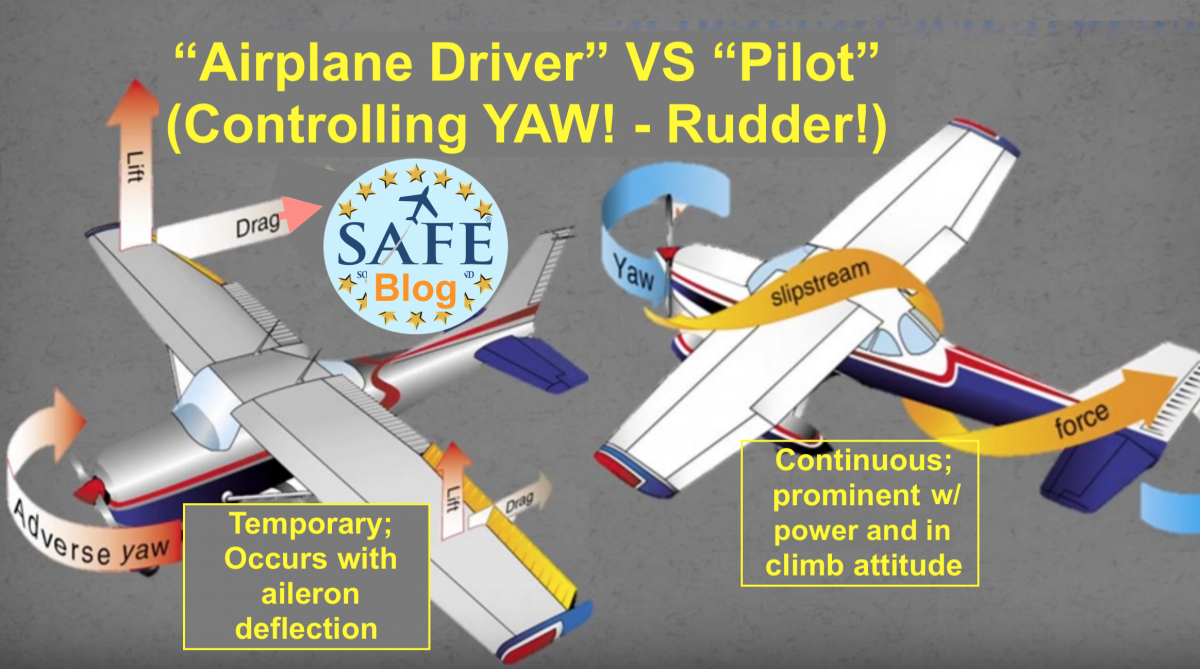
 We had 45 professional aviation educators at the “You Can Fly Center” for our SAFE CFI-PRO™ workshop this week. These dedicated professionals (half with more than 20 years teaching) really inspired me to present some deeper flight fundamentals. Proper rudder usage – yaw canceling – is often skipped in early flight training but is critical to flight safety. Most new pilots can program a G-1000 but not coordinate a climbing turn. And unfortunately, misuse of the rudder here leads to the “stall-spin accident” (really a “stall>yaw<spin accident”). Understanding and compensating for yaw takes a little effort since rudder effects are very non-intuitive (stay with me here!) If you don’t develop this critical skill in early training, you are probably skidding all the way around the pattern (an “airplane driver” and not a pilot). Please check your skid ball as you make your next crosswind turn; here is the “how and why” of that maneuver.
First, please watch this short video from Gold Seal. Russ does a great job clarifying adverse (temporary) yaw.
 Adverse yaw is a transitory yaw effect caused by aileron deflection and gone once the aileron is back to neutral again. By contrast, spiraling slipstream produces constant yaw on every plane as long as power is being produced. Airplanes fly in a continuous spiraling vortex of air created by the propeller. Manufacturers engineer out this force in level flight at cruise power by offsetting the vertical stabilizer and other mechanical tweaks. But spiraling slipstream must be compensated for in the climb; your plane is slower here and the forces in a climb are more prominent due to angle of attack.

To be coordinated while climbing straight ahead (spiraling slipstream plus torque and P-factor), there is a neutral point of rudder balance (yaw canceling) requiring constant right rudder pressure while the nose is up in a climb. As we roll our climbing plane left, some left rudder (or reduced right rudder) is required to compensate for the temporary adverse yaw of the aileron deflection. But once in a constant bank left climbing turn, we are back to the original right rudder pressure for spiraling slipstream and other forces. Constant right rudder is required in a climbing left turn. Rolling out of this left turn oto downwind requires a huge amount of right rudder (you often see noticable left adverse yaw as a novice tries to pick up the left wing with just aileron). Rolling right in a climb requires compensating for the additive effect of spiraling slipstream and adverse yaw. CFIs must carefully monitor their pilots in training to be sure both the understanding and actions are correct here.

I know all of this seems complex and non-intuitive, but various simple rudder exercises practiced at altitude make yaw sensing more natural. These forces must be understood first on the ground with a briefing then practiced and reinforced in flight (see a rough draft of our SAFE Extended Envelope Training) Keeping your eyes directly over the nose outside (guideing your student’s perception) makes, yaw more easily apparent. Another clue is your body’s natural leaning right or left to compensate for the yaw (very obvious from the back of a tandem aircraft). Once yaw canceling becomes natural it is transparent and habitual and part of a safe pilot toolkit. A coordinated plane responds correctly and flies more efficiently. As an added benefit, your passengers feel physically better without the yaw too. Fly safely out there (and often)

Join SAFE to support our safety mission of generating aviation excellence in teaching and flying. Our amazing member benefits pay back your contribution (1/3 off your ForeFlight subscription)! Our FREE SAFE Toolkit App puts required pilot endorsements and experience requirements right on your smartphone and facilitate CFI+DPE teamwork. Our CFI insurance was developed by SAFE specifically for CFIs (and is the best value in the business).

Tell us what *you* think!