
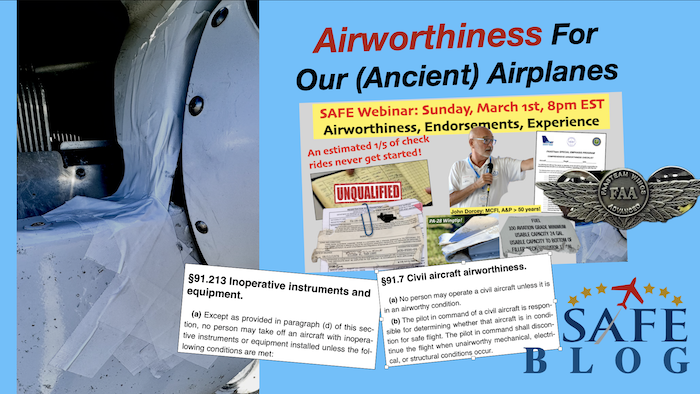
 The average GA plane is ancient; usually older than the pilot flying it. Consequently, we usually have to accept some airplanes that are “less than gorgeous.” For safety, however, we need to carefully verify that they meet the FAA’s “airworthiness” standards (see definition below). In this blog will carefully define and explain “FAA airworthiness” as a legal requirement. After that, every pilot must make a personal decision if the airplane presented meets their *personal* standard of safety.
On flight test day, it is especially important to dig deep on airworthiness, since a representative of the FAA (your DPE) will also be reviewing the paperwork and inspecting the aircraft. An estimated 1/5 of checkrides never get started due to deficiencies in pilot experience, endorsements, or airplane airworthiness. We will discuss these issues in even more detail on March 1st during a live SAFE Webinar. This blog is only a general overview to help launch that discussion.
Everything Must Work Like New
Finding an FAA definition of “airworthy” is not in the usual place: CFR Part 61.1 “definitions,” but can be found in CFR 3.5 “Airworthy” means an aircraft (and component parts) conforms to its type design (TCDS) and is in condition for safe operation.” (see FAA Doc) In summary, everything on the aircraft has to work just as it did when it rolled off the assembly line. If it doesn’t pass this first test, pilot action – and sometimes AMT intervention – is required before flight. Regular FAA-required inspections are designed to assure safety and compliance on a regular basis. The preflight assures this on every flight. Airworthiness Directives (ADs) are issued to fix original design flaws discovered *after* certification – e.g., those sliding Cessna seats and non-grounding magneto switches.
“Like new” is a high bar to clear, but this is where airworthiness begins (and how safety is assured). The first assumption is that everything on the airplane must work as it was originally designed and specified in the Type Certificate (the original engineering standard for the airplane). So if anything is *not* working as originally designed, a structured decision process must be followed to determine if the inoperative item is required by the FAA for safe flight.
Is it “FAA Required?”
Th e most accurate and comprehensive list for your particular aircraft is the equipment list in the POH. An approved POH (Pilot Operating Handbook) is only *FAA required* in aircraft put into service after March 1st, 1979. The POH (usually) contains an equipment list and in newer models will also supply a “Kind of Operation” list (KOEL) for specific operations. The POH goes way beyond CFR 91.205 or acronyms like ATOMATO FLAMES (CFR 91.205). The regs only contain generic guidance applicable to *all* aircraft. The plane you bring to the flight test, perhaps a CE-172, has a detailed “equipment list” (Section 7) coded for your particular aircraft. Based on your operation, you need to analyze what is legal to inop (under CFR 91.213d) and decide whether the lack of this equipment creates an unacceptable risk.

Inoperative Instruments and Equipment
 The procedure required for “legally altering” your aircraft so you can legally fly it is covered under CFR 91.213(d) and gets a lot of ink in the aviation community. The details go beyond this discussion. In brief, CFR 91.213 requires a pilot to remove (which may require an AMT) or “deactivate and placard” the instrument or equipment. This action must also be recorded in the maintenance logs. Every flight test applicant must be able to discuss and explain this process per ACS. The important takeaway is that *anything* inoperative renders an airplane “unairworthy” immediately until a determination is made and the airplane is “legally altered.”
More with the SAFE March 1st Seminar
Join us for more on all this on March 1st at our SAFE Webinar. This program is approved by the FAA for Advanced WINGs credit if you stick around to answer the 10-question quiz at the end. We will also discuss endorsements and experience if time allows. We need to fix this problem of unqualified flight test candidates; it wastes DPE appointments and ruins everyone’s day. Fly safely out there and often.
 Join us March 1st for a live SAFE Webinar that will cover this topic in more detail (with some more highly qualified A&Ps🤣). Airworthiness is an often-neglected subject that needs more pilot focus. We will also discuss the lack of pilot experience and CFI endorsements we see on flight tests that lead to unqualified candidates.

Tell us what *you* think!