
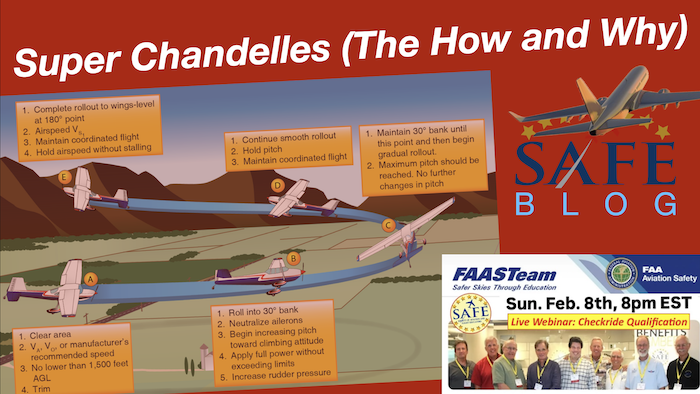
Like many aviation maneuvers we train and test, chandelles are “non-operational.” That means they have no practical application in daily flying. For this reason, some people object to their necessity at all and argue for their elimination from the ACS. (They would delete the whole Chapter 10 of the Airplane Flying Handbook). But chandelles build and demonstrate essential piloting skills, leading to mastery of the aircraft and safer flying. This is why chandelles are in the commercial ACS. They improve rudder coordination and pitch control during climbing turns. They are a great skill-builder for *all* pilots.
 If you consider that 89.3% of pattern stalls happen on take-off and turn-out (yaw and pitch mishandling with high power and high nose), mastery of chandelles would make every pilot safer. Intuitive (muscle memory) rudder control results in proper coordination that prevents stall spin accidents (often preceding LOC-I).
At the heart of the chandelle is a paradoxical necessity known as “cross-coordination.” Many new pilots think that crossing the controls is, by definition, dangerous. As a consequence, many pilots with this misconception climb and turn (especially in high-power aircraft) uncoordinated (and hence dangerously). Many pilots fly a complete traffic pattern in a skidding condition due to failure to add the required right rudder.
In stabilized climbing turns (like in the pattern), right rudder is still a necessity – just like in a straight climb. A right or left climbing turn (especially in the exaggerated pitch of a chandelle) requires aileron in one direction and the rudder in another to maintain coordination. The last part of a right chandelle has the right rudder almost to the floor, with the ailerons twisted to the left. This cross-control results in coordinated flight. The rudder is necessary to counteract all the climb forces. The plane is safe and stable, with the ball centered. just a whisker below stall speed, demonstrating flight mastery!
How to Fly a Chandelle (AFH Chpt. 10)
The chandelle is a maximum-performance 180-degree climbing turn, starting in cruise flight and ending at Minimum Controllable Airspeed (MCA). The first 90 degrees of turn requires a smooth pitch increase with a thirty-degree bank and the simultaneous application of full power. The *ideal pitch* (which will result in the perfect deceleration to MCA) is achieved by the 90-degree point of turn. Passing the first 90-degree point, the plane is smoothly rolled to wing level through the last 90 degrees of turn. To maintain coordination and the proper pitch, ever-increasing control pressure is required (due to increasing left-turning forces and diminishing control effectiveness) . Opposite aileron prevents proverse (yaw-induced) roll. It takes a bit of practice to find the “ideal pitch” (about 12 degrees up) and develop the smooth control handling to master this maneuver. The secret of “non-operational” maneuvers, though, is that all your flying will benefit from this practice and performance.
Baby Steps First (always start with the basics)
 Before you attempt to fly (or especially teach) a maximum performance climbing turn, practice coordinated Vy and Vx climbing turns at a constant airspeed. This will give you a feel for the rudder. Please notice that the coordination in climbing turns also results in a much better climb performance on the VSI (immediately visible reward). This practice trains your muscle memory for rudder application but also your “yaw detector” (the sliding feeling in your seat when you are uncoordinated). Fly safely out there (and often)!
 Join us Sunday evening, February 8th, at 8pm EST for a live SAFE Webinar on Checkride Qualification. An estimated 1/5th of checkrides never even get started because the applicant lacks the requisite experience or endorsements or shows up with an unairworthy aircraft. Veteran MCFI (and A&P) John Dorcey will join me for this show (and also hopefully DPE/A&P/IA Peter Treichler if he gets free from his airline responsibilities). All of us DPEs have seen some amazing airplanes presented for flight tests.
  FAA Advanced WINGs will be available for attendees who take the associated 10-question quiz after attending the showl
Tell us what *you* think!