
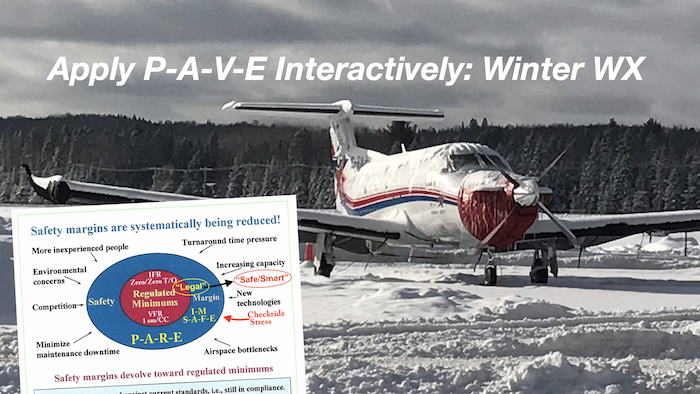

 The whole ACS training/testing system is built on creating (and maintaining) a safety margin between what is “FAA legal” and what is “Safe and Smart” in flight. If you want to pass your FAA practical test – and subsequently stay alive as a pilot – understanding and internalizing this paradigm in all operations is essential. Pilots who advocate for “FAA minimums as an operating standard” scare me to death. We live with a “safety margin.” In the red zone, on the edge of “FAA legal,” a pilot is already in very dangerous territory. The FAA, under Part 91, only specifies absolute minimums. Maintaining a “safety margin” is essential for safety.
The “Pilot-Aircraft-enVironment-External pressure” acronym, displayed above in graphic form, defines and maintains this safety margin. The dimensions depend on many personal factors, such as experience, skill, recent training, familiarity, etc. And precisely because these standards are personal, the defining line can get fuzzy. What is critical is defining the starting limits and maintaining these throughout flight. Every specific planned flight will require some modification (see Eisenhower). But the safety margin in blue must be immutable for safety.

Pilot Vs Aircraft
What is often misunderstood in the P-A-V-E acronym is the interactivity between the risk factors. A great pilot, with no knowledge of the specific airplane or environment, is obviously dangerous. One of my first “learners” as a new CFI was an Air Force General (and combat veteran) with >3500 hours in F-16s. My job was transitioning him into civilian flying in a Grumman Tiger. This is an example of an absolutely amazing pilot with limited recent experience in GA aircraft or the civilian system; a totally new world.
As a CFI, have you ever tried to transition an airline pilot back into a little GA plane? This can be scary (and dangerous) without extensive ground time and a clear plan of action. Airline pilots only perform a small percentage of the piloting tasks required of a GA pilot. They are part of a larger team performing the same tasks required of GA pilots (and the GA environment is much more challenging and unpredictable). Dispatch, maintenance, and weather analysis are handled by a team of specialists. This knowledge and skill need to be rebuilt for GA safety. And of course, the landing height and energy management with limited technical assistance are going to be very alien as well; great pilots, but new plane, and environment.
Pilot and Aircraft Vs Environment

As we deal with winter weather ops in the north this time of year, the “Environment” area needs careful attention. Even the most capable GA piston without FIKI certification is vulnerable. The FAA has stepped up with some very good training on winter ops. Some historic articles and a winter weather focus in the FAA Safety Briefing Magazine are also useful. Fly safely out there and often🙏.
 Check out these additional resources in the SAFE Blog by clicking on the image at left. Also try our embedded AI search tool for more information (trained on the SAFE Blog content.
We are planning our next webinar at the end of this month on “Maintenance Requirements for Checkrides.” A large number of planned testing opportunities are still wasted (Unqualified) because the DPE refuses to accept the planned aircraft as airworthy and acceptable. Sometimes this is a lack of correct documentation, and sometimes it is observed deficiencies. Applicants, CFIs and DPEs all need more understanding of the requirements here.

Tell us what *you* think!