

Pilots reveal their level of experience and discipline most clearly to the world with their radio phraseology. We have all heard a new learner on frequency struggling through their first attempts with the radio. Hopefully, we all commiserate with this “word salad;” we all were there once. For CFIs in the group, I highly recommend a printed script to ease these first attempts. Too many CFIs take over the radio for beginners (avoid the cringe) and the newbie consequently learns nothing. New pilots need the practice; ATC phraseology is initially a foreign language. When an experienced pilot is babbling non-approved phraseology, it is unforgivable and dangerous. Specific phraseology is essential to avoid ambiguity and dangerous deviations from directions. The “point six five” will reveal how specific and precise controllers speak (usually). This is a discipline pilots should model.
The most irritating violation of standards usually comes when a pilot wants to use the runway for takeoff in a controlled airspace. “Ready to go” is common – and usually forgiven outside of busy airspace. The more intense the traffic situation, the more precise and precise your phraseology must be.
“Request Takeoff”
 What is the actual *correct* way to get a clearance for take-off? (Please spare me the comments on this one) The correct phraseology is remarkably simple: “Holding short RXX, Request takeoff.” If something other than runway heading is desired, simply add your desired departure to the request: “and right turn to the west.” That second part of this request is the “departure clearance.” Pursuant to that, a pilot should never “request departure” at the runway holding line or say “ready for departure.” Have you ever heard a controller say “clear for departure” as a takeoff clearance? They are approving a specific pilot action; and that is the takeoff. “Request takeoff” please: clear and succinct. I will be the first to admit that almost anything a pilot utters holding short at “Cornhusker Muni” will be followed by “cleared for takeoff.” Most rural level one VFR towers are used to complete chaos at the hold short line. Whatever you say, they roll their eyes and clear you for T/O. But if you want to be a professional, use the phraseology that will work at Laguardia or Teterboro.

“Request” is a magic word when you need something from ATC. That followed by the action you are seeking, “request on course,” immediately cues the controller they are speaking to a pro. If it is an initial contact, begin with location and your flight status. “12 miles north, VFR Request.” Many Level One VFR towers have no radar and only know where you are by what you say (no radar here – accuracy is critical). If you are already in contact (or on a discrete code with a facility) you can eliminate the location if it is busy.
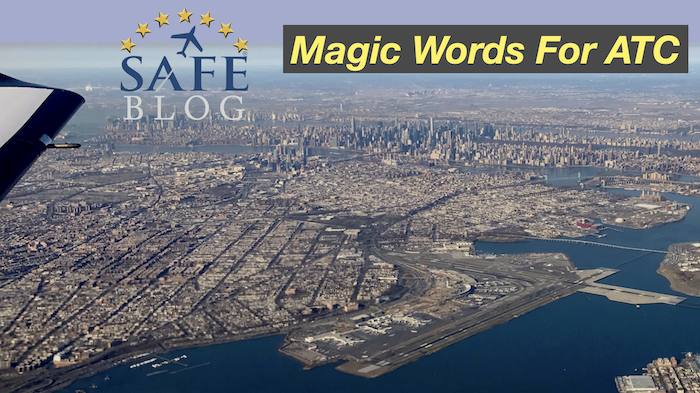
 If you are flying in a dense traffic situation (radio is buzzing), “eliminating the obvious” is essential (but not actually approved by the “point six five” or the FAR/AIM glossary) In busy airspace the rule is “essential to efficient” communication. At 17:00 in the NYC airspace, on the handoff, it is often too busy to even check-on with the new frequency (at 119.2 headed south into KCDW, KTEB). The radio here resembles an auctioneer just reading call signs and directions non-stop. Just listen for your call sign, readback accurately and comply. If you miss a call twice you will be vectored to outer darkness.
“Unable”
 I fly with lots of newer pilots who are not yet comfortable with “command authority;” CFR 91.3. This is especially true with ew CFIs having only 10 hours of solo! It is critical to safety that every pilot know their capability and limits; both aircraft and pilot. If ATC requests something that is not possible or safe, it is essential to state this clarity: “unable!” In these cases also add what *might* work or is desirable to the situation so the controller knows your issues. In cases like this, if a pilot accepts a clearance and cannot accomplish the action, this creates an even worse situation. Saying “unable” or “student pilot” will cue them in if you are still learning and the requested action is beyond your capability. In most cases, I do not recommend starting every transmission with “student pilot.” If a pilot is this weak, they probably should not be soloing in that particular airspace. IF a situation arises beyond your control, play that card. If all else fails, resort to “plain English” and resolve the situation. (“say again” is valuable, but does not help if you don’t know what the original instruction means
The meek shall inherit the earth but they will not make very good IFR pilots!”

IFR Operations
 A good percentage of failures on FAA Instrument Evaluations are the result of applicants “allowing the controller to fly their aircraft.” They accept vectors and approach clearance when they are not fully set up and briefed. This usually ends up in chaos with the applicant way behind on the procedure all the way down final. This is (again) an abrogation of PIC authority. A simple “request”for vectors or delay is essential to safety (and success on every IFR flight). A controller assumes a certain standard level of proficiency and cannot know your workload (or fatigue). Share your needs with a “request” and there will be less chaos and danger.
Mouse on Frequency

Another problem that follows from the lack of command authority is a lack of confident vocalization on the radio (mouse voice). Not only is this hard to hear on frequency, but the weak and timid voice will often lead to “kid glove” handling. Any sensible controller will naturally treat your operation more carefully, despite your proficiency. If you sound weak and lack confidence, you will be vectored wide, held further from any potential interaction with traffic, and basically get handled like a new learner. If this is appropriate, no problem. But unfortunately, many pilots never learn to speak up and advocate for what they want/need (confidence).
Confidence is not an exclusive trait, but a skill accessible to all, and with the right tools, you can harness it when it truly matters.
Be polite, but be “in command.” Listen on live ATC more and you will hear the effective/efficient pro pilots and also the church mice over their heads. Then decide who you would rather be and work on your radio skills. Fly safely our there (and often)!
 Join us on October 19th, at 8pm for a FREE SAFE Webinar on Commercial Pilot Professionalism. With the disappearance of retractable training/testing and also “real solo,“ Commercial is rapidly becoming “Private Pilot 2.0” even testing in the same basic trainers. What can be added to define professionalism at the commercial level? Enter your ideas on this Google Form, and sign up to attend HERE.


Tell us what *you* think!