
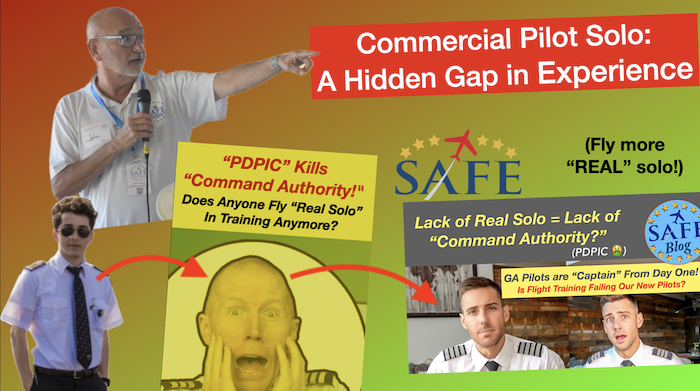
Thank you to John Dorcey, founding SAFE member and former SAFE Executive Director, for this important article. John has been a flight instructor (and AMT) for more than 50 years and is still very active in educating new aviation learners.
 A learner pilot working toward a Sport Pilot certificate must log at least five hours of solo flight, including a cross-country of 75 miles. A Private Pilot applicant, under part 61, requires a minimum of ten hours of solo time, with five of those hours devoted to cross-country. In both cases, flying solo is not just a requirement — it’s an essential step toward becoming a confident, safe pilot. Solo means flying completely alone, without an instructor. It’s where students build judgment, learn from mistakes, and discover what it truly means to command an aircraft.
But what about pilots training for the Commercial Pilot certificate? Surprisingly, they are not required to have any additional solo experience. In fact, an applicant for a commercial certificate is not required to fly any solo beyond the time they logged as a Private Pilot applicant. No additional solo, no independent decision-making, no new confidence building. The very experience that shapes safer aviators is left out. Most new academy CFIs begin instructing with only 10 hours of solo flight!

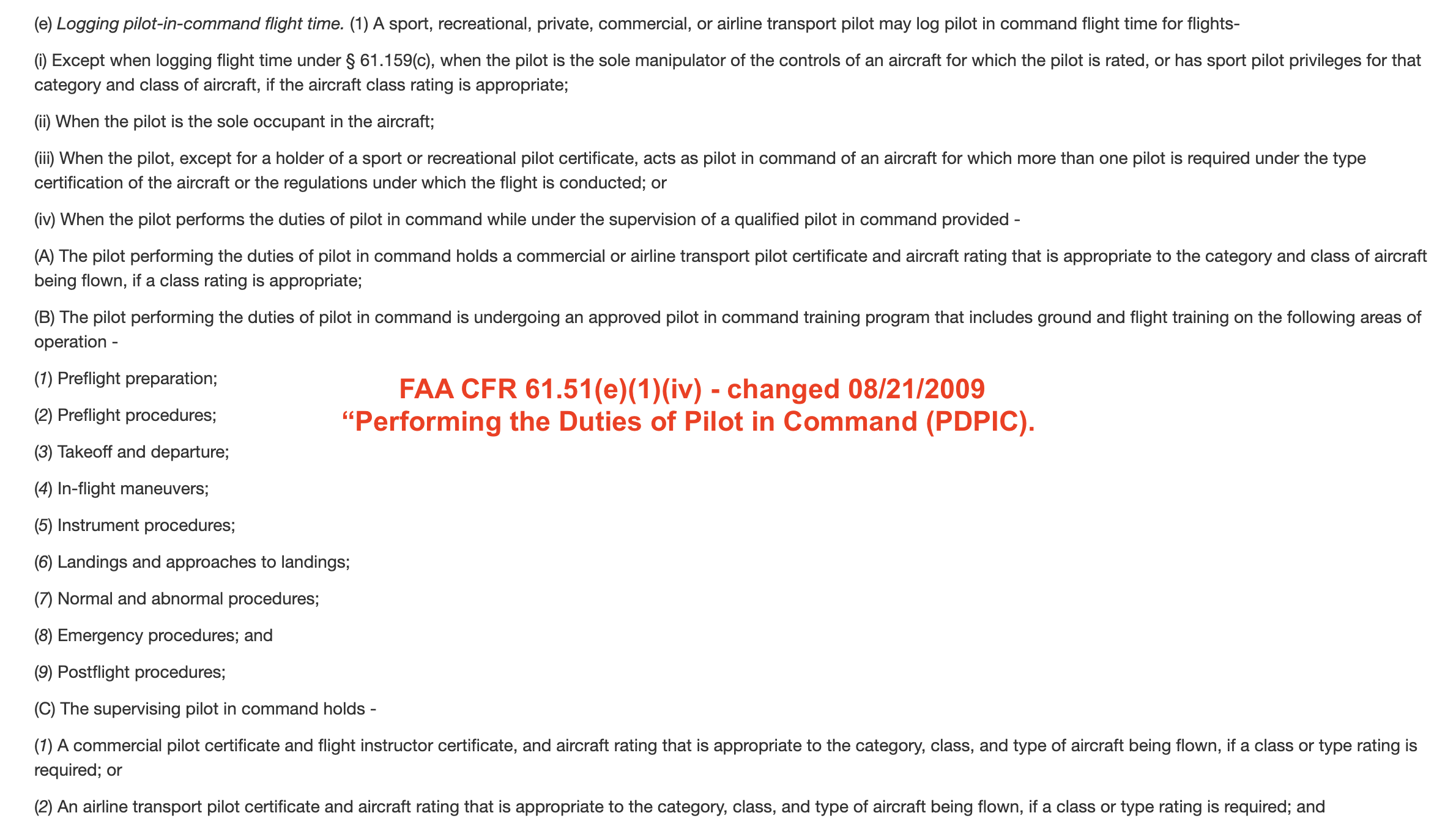
This gap comes from FAR 61.129 (permitted by 61.51(e)(1)(iv) – changed 08/21/2009). This regulatory guidance outlines aeronautical experience required for commercial applicants. Most students train in single-engine airplanes, so consider 61.129(a)(4). The regulation requires:
“Ten hours of solo flight time in a single-engine airplane or 10 hours of flight time performing the duties of pilot in command (PDPIC) in a single-engine airplane with an authorized instructor on board.”
It’s that word “or” that troubles examiners and instructors. PDPIC may sound equivalent to flying solo, but it isn’t. With an instructor on board, the student doesn’t experience the full weight of independent command. As a result, a commercial applicant could reach their flight test with only 20 hours of solo time — a shockingly small amount for someone pursuing a professional certificate.
 Every Airman Certification Standards task requires applicants to demonstrate skill, judgment, and risk management. But how can a pilot meet these expectations if they’ve had little true solo experience? To borrow William G.T. Shedd’s words, “A ship is safe in harbor, but that’s not what ships are for.” Likewise, pilots cannot become confident leaders on the flight deck if they are never required to leave the airport — alone.
If our goal is to develop safer, more capable aviators, then solo flying should remain at the heart of pilot training, all the way through the commercial level.
There are many FAA Letters of Interpretation (LOIs) on this subject.
Grannis, Apr 2016
Kuhn, Feb 2014
Dean, Feb 2013
Sun, Aug 2011
Olshock, Mar 2007
SAFE “CFI NOTAMs“ clarifying common CFI mistakes.
SAFE archive of common LOIs
Fly safely (and often). Join John Dorcey on Sept. 14th at 8pm EDT for a live SAFE Webinar explaining a thorough Instrument Proficiency Check.


Tell us what *you* think!