
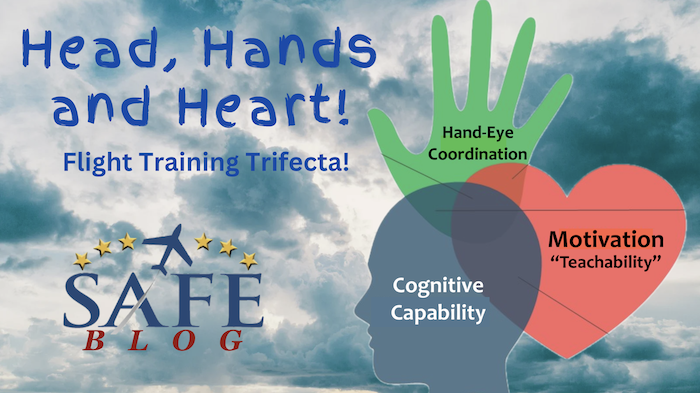
 There are three necessary ingredients to enable the creation of a safe and effective pilot. I personally code these as “head, hands, and heart” to facilitate simple identification and analysis; cognitive ability, hand-to-eye coordination, and motivation/teachability. Each gift is actually a cluster of capabilities that I look for carefully in every pilot candidate I teach or test. Some combination of these attributes seems to be necessary for ultimate success as a pilot. We can supplement and compensate for a deficit in one area to some degree. But sadly, extreme deficits cannot always be safely overcome – as we shall see.
 Cognitive capacity and hand-to-eye coordination seem to be mostly gifts of nature (or developed early during the “growth opportunity of youth”- like languages). Some functionality can be improved in adulthood but only to a certain degree – there are physical boundaries. Working in LSA aircraft, I have successfully overcome some amazing physical deficits with learners – the Jessica Cox-type people. High motivation can overcome many deficits. And though for years, I thought otherwise, motivation – heart – is an area of great promise for all educators. Motivation *can* be built and bolstered. Motivation is the engine that drives flight training. It can, to a great degree, overcome deficits in manual skill or cognitive capacity.
Head, the Cognitive Tools
A person does not need to be a genius to fly a plane safely (thankfully). But obviously, more complicated systems necessitate greater cognitive capacity. To a degree, motivation and hard work can compensate for a genetic lack in this area. I have met amazingly hard-working pilots who adapt well here; we are not flying the Space Shuttle.
 Ironically, greater intelligence is occasionally also a barrier to aviation success. Working in an academic town, I have met true geniuses whose over-intelligence and perseveration prevent effective piloting (one I had to sadly tell to never fly for safety). Higher intelligence sometimes seems to travel with perfectionism – and even autistic tendencies – that prevent the mental flexibility necessary to pilot safely.
I trained one extremely high-IQ savant (tested 180+) who absolutely could not deal with any sudden change in the plan or environment. Any significant change emotionally upset him to the level that he totally lost functional ability; he “melted down!” He was cognitively so tightly scripted that any variation destroyed his ability to function and continue (not workable in flight). Extreme perfectionist tendencies prevent the adaptability necessary for successful aviation. If the plan changes, many cognitively rigid pilots are disadvantaged to a degree. Though their planning is typically extensive and admirable, when the weather or environment throws them a curve they cannot quickly cope and adapt (critical safety skills in our world).
 Other mental qualities are essential for aviation success. Resilience is an essential piloting skill that does not correlate psychologically with intelligence. The ability to emotionally accept setbacks and push on tirelessly is a trait Angela Duckworth at Penn identifies as “grit.” This is a distinct and critical component of success in most high-performance challenges. Dr. Duckworth tested military cadets at West Point during “beast week” and spelling bee contestants to develop a “Grit Scale.” Her well-written best-selling book explains the importance of this trait.
The most effective mental posture for successful (and safe) aviation seems to be the stoic disposition. Hoping for the best while simultaneously planning for the worst – cautious optimism – provides the flexibility to handle challenges while not defeating opportunities. I often compare this to a football quarterback as the ball is snapped. We need a solid, practiced plan of action, but must expect changing conditions, and execute on opportunities. Our profession demands the careful, flexible – even artful -execution of available options.
Hands, The Motor Skills
 I have had the privilege of working with a few “golden-hands” pilots, who also had the mental capacity and motivation. Two of my students became “top hook” pilots in their Navy training. In my world, these are often people who have grown up with heavy equipment in farming families. Here they experience the “double blessing” of both manual training and trustworthy independence – natural PIC for piloting. As youngsters these people were independently and responsibly driving tractors on the farm by the age of 10. Introducing these people to aviation during a “Discovery Flight” is fascinating: “Are you sure you never piloted before?” I have
  completed some gifted people easily in the 141 minimum 35 hours since they had the trifecta of hands, head, and heart (and we were lucky with the weather). On the other hand, one unfortunate “golden hands” was not blessed with the mental capacity to safely pilot. He was a heavy machinery operator who mastered the mechanical operation of the plane in only 5 hours (and could easily have soloed). Unfortunately, he completely lacked the mental capacity to fly safely – so sad!
Heart, The Motivation
 Motivation is a largely untapped opportunity for education because it is often misunderstood as a “nature” rather than a “nurture” attribute. But motivation *can* be created by a patient and compassionate educator. The pathway to inspiring this magic power is curiosity. If a talented educator can light the spark of curiosity in a learner, they immediately get “focus for free!” And once attention is acquired and a channel of communication is established which can build into a “virtuous cycle” of intrinsic motivation. This is the magic of the youth-level STEM programs that have become increasingly widespread in the US. Curiosity (and peer affiliation) inspire the first steps that lead to passion, autonomy, purpose, and ultimately mastery (more on this next week). A certain amount of “teachability” is also essential to enable the educational relationship. Fly safely out there (and often)!

Join us this Sunday March 23 for a free webinar on flying the CFI initial evaluation. This demonstrates the “split-brain aptitude” of flying, talking and avoiding danger while in the air. CFI-PRO™ provides the “Missing Manual” of how we really teach. 
Tell us what *you* think!