dvis3yzawwgr9p4du4g7rcqsie1vi7

Personal Perfection and Flight Test Myths

Published on

in

A look at perfectionism

Perfection is an important goal in flight training and piloting. We should always aim for the highest standards,. But everyone needs to understand that perfection, by definition, is not achievable (especially on a flight test). Perfection is also not the standard for a successful flight test. All FAA evaluations enforce a pass/fail (70%) standard.“Perfection is not the standard.” It is important to emotionally prepare for some stuff to go (mildly) wrong. I have been a DPE  for >25 years giving lots of tests, and have personally taken >50 flight evaluations myself; stuff happens!

Emotionally Prepared?

Unfortunately, many flight test candidates ruin their performance on flight tests with self-defeating criticism of their own performance (guilty). As soon as a few minor errors occur, many applicants are crushed – psychologically and  start to give up! It is critical for test success to remember,”stuff happens” in all flying. The goal in flight testing – and flying – is to always be correcting back to a high standard. Subsequent reflection (after action) is an important pilot trait, but in the heat of battle, don’t let that “Perfect Polly” ruin your flying. Your DPE is required to inform you when a maneuver is unsuccessful. If you hear nothing, suck it up and keep flying. Remember, a maneuver may  not meet *your* standard – it is test day, after all, and you’re nervous – but the FAA test is pass/fail.

Some Common Social Media Myths:

How to *NOT* Choke!

“Sorry you are the fifth flight test candidate and I need to keep my failure rate up!” is the mythical DPE secret you don’t want to hear as you pay for your flight test. Social media is full of all kinds of flight test rumors so I thought it might be valuable to discuss a few here. It *is* true that the private pilot test has an increasing failure rate now exceeding the initial CFI level. I think this is because PPL is a pilot’s first experience with FAA testing and they are often not adequately prepared – psychologically and also informationally – for that first FAA testing experience. To that end, let’s discuss some common “DPE mythology.”

DPEs *Do Not* have an FAA  failure quota!

A DPE failure quota is often used as an excuse for why a checkride is unsuccessful by either the applicant or the recommending CFI. This myth rationalizes a candidate’s failure as caused by an unfair FAA policy (which is totally false). This myth is also spread by CFIs that fail to fully prepare their applicants. PPL is especially difficult for new applicants.

If you are unsuccessful on an evaluation, your Notice of Disapproval must clearly state the reason(s) and every DPE owes an explanation to the applicant for what was missing or wrong so a future attempt can be successful. All these comments travel with your IACRA file and are visible to another DPE on your next evaluation. And all the wrong answers on your knowledge test are required to be retested by the DPE – so be sure you practice the correct answers.

You can look it up, and make (a few) mistakes!

Not just acronyms; “describe/explain!”

This is a practical test, so you can refer to your guidance (but not continuously and for everything – this is not a Google search competition). If it is something you might need in flight, your references are mostly limited to checklists and kneeboard items. TO that end, it is important to have a working knowledge of your reference materials so it is not an “Easter Egg Hunt” through the FAR/AIM.

Regarding mistakes, the FAA clearly states in many places that “perfection is not the standard!” When the 8710 is submitted, an applicant is theoretically at 100% (you are whatever your CFI says you are with their endorsement) and errors are marked down to the pass/fail 70% level. The FAA evaluation is the DPE “checking” your CFI’s preparation and recommendation. Though perfection is not the standard, it certainly is the goal. Remember, all the FAA test standards define the *minimum* acceptable performance. A conscientious CFI trains to a higher standard than the minimum for recommendation; e.g.  +/- 50 ft, since you will be nervous and this will not be your “best flight ever!”

In the oral, an applicant must demonstrate a pattern of incorrect understanding to be issued a disapproval.  In flight, the ACS states the applicant fails for “Consistently exceeding tolerances” or “Failure to take prompt corrective action;” keep flying and correcting back to the standard.

With that said, there are certain “one-off” (non-correctable) failures that will result in an immediate disapproval: the famous commercial 180 power-off accuracy landing is an example. Exceeding a published limitation or examiner intervention for safety is also an immediate unsat. In most cases though, like the oral, a DPE is looking for a pattern of sloppy flying, lack of knowledge, or poor risk management.

The DPE has to test within the FAA standards!

DPEs are legally limited to the items stated in the ACS (and the reference materials) by the FAA: this is not a “personal test.” It should not go out of the listed FAA Areas of Operation and Tasks. Evaluations with a “selection process” (Initial CFI) still require an applicant to be fully trained and proficient in *ALL* listed maneuvers (in case they are chosen by the DPE). Additionally, on any retest, the DPE is allowed to evaluate additional tasks (previously “passed”) if it seems like they are questionable (taxi to the wrong runway without a taxi diagram?).

The pilot evaluation process is admittedly subjective no matter how many standards and criteria the FAA creates (or it would be a CloudAhoy data track). Show up on time and be respectful, dress and act like a professional. The FAA works very hard to assure fair and honest evaluations, but there is always the human element on both sides. If your test was way off the mark – asking inappropriate questions or exhibiting inappropriate behavior –  the FAA wants to know. Talk to your FSDO or use the FAA hotline. This assures anonymity and whistleblower protections: 866-TELL-FAA (866-835-5322) Every future applicant will benefit from your input.

Your Best Success Strategy

Start with a good knowledge test. Then eliminate surprises by reading the appropriate ACS carefully cover-to-cover. Take notes and make sure you have a full understanding of all the material and maneuvers. You should not be surprised if your DPE asks for a turning stall or a slip to land. These are in the ACS: no surprises. You *will* perform all the listed maneuvers and emergencies (unless it is a selection standard) and your reference is your aircraft’s POH (immediate action items not internet BS)

From the POH please!

Another important (and mostly neglected) skill a pilot applicant needs to master is the ability to verbalize their information. This is underappreciated. Flight tests do not require “teaching,” (unless it is a CFI evaluation) but every applicant must be prepared to “describe and explain” their knowledge clearly. Quietly reading through an “oral test guide” and saying “I got that” to yourself will not prepare you to verbalize the required information. Practice out loud with another applicant until you can present a fluid version of the relevant information.

Another important point is just answer the question and then be . Avoid talking to the edge of your known subject or bringing up new questions that will trip you up. The DPE will ask for more if your answer was less than complete or needs clarification. Never guess or fabricate an answer. An honest “I don’t know” or “I can look that up” is the correct (honest) answer.
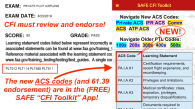
It does help to ask other recent pilot applicants about their experience, but don’t get too deep in to social media rumors. The “SAFE Toolkit” App (free) has recommendations and videos from current DPEs with all kinds of valuable advice.  See the “Checkride-Ready™” tab for all levels of certificates.

Finally, don’t rush into any evaluation because someone is pushing you to get done. You are ready when your CFI says so are *and* you feel fully prepared and confident. You paid a lot to get to the finish line, and the test is not cheap either. Fly safely out there (and often)!

CFI Survival Guide

Overcoming Flght Test Anxiety


Join us for a free webinar on flight control usage, “energy errors, and the new CFI ACS MCA maneuver in our January Webinar with (CFI/PhD) Juan Merkt. 90% of pattern stalls occur on take-off and turn-out (high power and high AOA/pitch attitude). Training at MCA creates an intuitive correct use of the rudder (and an awareness of “the feathered edge”). LOC-I is the #1 causal factor of fatal aviation accidents. MCA is precisely what pilots need to practice to fly safer (out of the “comfort zone!”)

4 responses to “Personal Perfection and Flight Test Myths”

  1. Dudley Henriques Avatar
    Dudley Henriques

    A Few Thoughts on Check Flights from both sides of the equation….the applicant and the check pilot.
    Dudley Henriques

    (I get a fair amount of back channel email on flight instruction
    issues and this issue has come up quite a lot lately. I’m reposting
    this in the hope some student might find it useful.)

    Let’s talk check rides for a moment shall we? It’s an interesting and
    important issue to all of us who fly, and I believe it deserves some
    special
    attention.

    I’ve noticed through the years that this issue comes up many times
    when
    pilots get together to talk shop. It’s an issue that all of us, from our pre-solo
    checks
    through our ATP route checks have to deal with sooner or later if we
    intend
    to remain pilots. We’ll have phase checks, flight tests, checkout
    flights,
    and continuing proficiency checks to deal with sooner or later in our
    careers. I’ve been both taking and giving check rides in airplanes for
    about
    fifty years now, and I believe I’ve learned a few things about both
    ends of
    the spectrum. With your indulgence, I’d like to pass some of what I’ve
    learned on to you, especially those of you just starting out on your
    long
    aviation journey,

    Let’s concentrate on the flight test check flight for a Private
    Certificate
    as an example. I choose this scenario because it’s really the first
    “serious” flight check you will receive as a pilot, and as such, many
    have a
    tendency to bring unneeded fear and apprehension into this equation.
    I’d
    like to address these possible fears and apprehensions, and perhaps
    steer
    you into a proper state of mind for taking on this all important
    check ride…..the one you have worked so long and hard to pass!

    Lets talk for a moment about attitude, then we’ll take a short look at
    the
    check ride itself, and how you should interface with the examiner
    during the
    test. You will notice immediately that I am shying completely away
    from
    maneuver technicalities and maneuver discussion. I think we can all
    assume
    that prior to taking a check flight for a certificate that you have
    been
    properly trained and recommended for the flight test. What I’m getting
    at
    here is above and beyond this. It concerns the attitude and mental
    preparation you take with you when you get into the airplane with the
    check
    pilot or examiner.

    First, and this is probably the most important single factor involved
    in a
    flight test; RELAX! Realize that the examiner doesn’t expect you to be
    perfect; the examiner expects you to be SAFE!!!!! Now, what does this
    mean
    to you? You should arrive for the test as prepared as possible. This
    doesn’t
    mean you have to know the answer to every question you will be asked.
    It
    means that if you don’t know the answer, you DO know exactly where to
    find
    it. It also means you should expect to make mistakes.This is extremely
    important so remember it; the examiner EXPECTS you to make mistakes.
    In
    fact, a good examiner WANTS you to make mistakes so he/she can
    immediately see
    if you can both recognize that you have made that mistake, and as well
    CORRECT the mistake within safe parameters.

    Now this point deserves a bit more attention, so listen up a moment
    here.
    Why are mistakes important to an examiner? Here’s the answer. The
    examiner
    is constantly asking him/herself all through your flight, “How safe is
    this
    applicant” “How would this applicant react to this or that if I wasn’t
    here?” These are important and pertinent questions. How does the
    examiner
    deal with this? ERROR ANALYSIS!!! That’s how! There is absolutely no
    better
    way to evaluate a pilot in flight than allowing that pilot to fly into
    an
    error; then view EXACTLY how long it takes for the pilot to recognize
    that
    error, and EXACTLY how long it takes to initiate corrective action,
    and most
    importantly, EXACTLY what that corrective action is!!! What I have
    described
    here is not only what a good examiner is doing, but also the formula
    for
    teaching someone to fly an airplane properly. A good instructor NEVER
    rides
    the controls on a student. A good instructor knows EXACTLY how far to
    allow
    the student into an error and makes every effort to talk the student
    through
    a correction without grabbing control from the student. Doing this
    correctly
    is the mark of both a good CFI, and a good check pilot……so remember
    this.
    Back to the examiner; they want to observe your errors, so if you make
    them,
    and you most certainly will make them, face the error immediately;
    state the
    error; and begin correction immediately. Nothing impresses an examiner
    more
    than a pilot who faces a mistake immediately by recognition and
    correction.
    Remember this!
    You will probably discover somewhere in any check flight that the
    pilot
    giving you the check does things a bit differently than you do, or how
    you
    were taught to do it. In almost every instance, you will find that you
    can
    do it BOTH ways correctly, so demonstrate it as the examiner suggests.
    In closing, let me say that it really all boils down to keeping
    calm…..being relaxed……and giving the examiner a SAFE, HONEST,
    flight.
    Recognize those errors…..correct them immediately….and when in
    doubt….take the SAFE option.
    Best of luck to all of you on your future check flights!!! :-))))

    Now from the other side of the equation; GIVING a check flight !

    It’s interesting sometimes, to explore some differences between
    instructing as a CFI and giving check flights as a CFI as the
    technique does vary a bit if you analyze it from an objective
    viewpoint.
    In the Instruction mode, there are many in-flight situations
    (perfectly normal) where a good instructor will demonstrate something
    as a negative by allowing the student to progress into a specific
    situation that under normal circumstances should be avoided.
    This is a controlled situation by the CFI and done completely in a
    safe environment classified as a “teaching environment”.
    In these “situations” it is quite common for “mixups” to occur where
    the student is performing something with the aircraft contrary to the
    student’s preconceived understanding and expected outcome.
    The result of such situations should produce an outcome that changes
    or alters the student’s preconception of that expected outcome to
    produce a new and better understanding and a new expected outcome.

    On the check flight side of the equation, you are now in a totally
    different environment. The objective now is to ascertain a specific
    level of competence that will allow safe operation of the aircraft.
    In order to make this decision, the check pilot is now placed in the
    role of observer as opposed to a teacher. The reason for this is that
    if the check pilot departs from the observer role and enters a
    teaching role, the pilot being checked can and most certainly will
    alter whatever it was the pilot would normally do or have done with
    the airplane to meet what is being demonstrated or taught at that
    moment.
    The result can easily become a teaching situation that is not
    optimized as a check flight.
    The pilot being checked performs as directed but less than what is
    needed to make a qualified judgment on the pilot’s knowledge and
    abilities can easily result.

    In the check pilot mode, it is imperative that a thorough
    understanding of EXACTLY what will be expected from the pilot being
    checked be completely understood before the flight takes place.
    This doesn’t mean the check pilot has to be rigid. In fact, most good
    check pilots are NOT rigid. In this environment you want a relaxed
    applicant with a thorough understanding of what will be expected and
    nothing else.
    During the flight, using any “technique” that attempts to trick the
    applicant into doing something that would fail the applicant is
    something I personally would discourage when advising check pilots.
    It’s important here to differentiate between a verbal instruction
    causing an act that fails the applicant and an instruction from the
    check pilot that offers the applicant a CHOICE of action!! There is
    nothing wrong with offering an applicant a choice of action and indeed
    in my opinion, is one of the most useful tools of any good check
    pilot.
    If check pilots brief thoroughly and perform correctly, all necessary
    information can be obtained without “tricking” the applicant into
    doing something that fails the flight check.

    Flight checks come in different packages of course and usually fall
    into two very distinct categories; the first being a structured check
    where governing authority has dictated a strict set of tasks that must
    be accomplished to pre-set standards.

    The second type of flight check involves a less standardized and
    structured format where the check pilot has some degree of latitude in
    determining what is covered and how it’s covered.

  2. Richard G Avatar
    Richard G

    Oddly, we have been pushing for standards, so everyone is tested the same.
    With ADSB tracks, it could be checked. In fact, it likely should be something sent in to be reviewed to see if everyone is being tested to the same. I’ve noticed the FAA and NTSB do go to the last Flight Instructor when there is a mishap to see if the instruction was the issue. DPEs are and should be checking for instruction issues. But this leads to instructors picking who they want checking their work.
    The DPE checking instructors work is what needs to be rotated.
    I agree, it doesn’t need to be a perfect flight. During one check ride, I caught myself programing an IFR flight using the starting airport ID as the beginning of an airway… and quickly noted airports are never a part of an airway even if the VOR is on the field… duh.

  3. […] the couch!”  Unfortunately,  some people get *SO* nervous they can’t perform at all (choke). This same disabling panic can also happen in flight emergencies with the startle response.  […]

  4. […] Aim for progress, not perfection. […]

Tell us what *you* think!

This site uses Akismet to reduce spam. Learn how your comment data is processed.


Thanks for Visiting!

Thank you for visiting the SAFE Blog. There are over 500 specifically tailored articles covering a wide range of aviation issues related to flight training both as a pilot and as a CFI. Search HERE for a specific article, and Join SAFE

Please try our new AI Tool (Chat 5.2 trained on SAFE Blog content) for your specific topics of answers to your aviation questions. SAFE crafted AI Tool


Notification Here!

Stay updated with our latest tips and other news by joining our newsletter.


Free SAFE Toolkit App

Everything a busy CFI needs at their fingertips, *plus* resources for pilot applicants: “Checkride Ready” (with all the DPE advice on how to pass your practical test) FREE Download

Discover more from Aviation Ideas and Discussion!

Subscribe now to keep reading and get access to the full archive.

Continue reading