
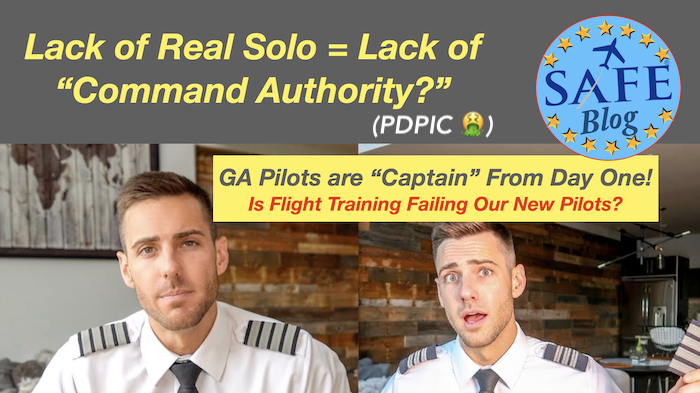
There is a “learning curve” in every skill acquisition project from beginner to expert. Early in the learning process, specific rote-level instruction is obviously vital. We start with nothing (and what we “know” may even create an erroneous negative influence). Early instructional feedback – largely rote -develops our muscle memory. Early guidance also sets the guardrails for safe exploration and growth in a new environment. As a learner progresses to higher levels of mastery, continuous feedback can actually damage learning and inhibit expert performance. The reason for this is an interesting phenomenon called “sensemaking.” Self-reliance and confidence are built with real solo time!
 Our raw perceptual input of the world is continuously overloading our systems. The way we make sense of this onslaught is cognitive filtering and framing. We exercise “predictive perception” (see, hear, etc what we “expect” to sense), and “motivated thinking” which draws predictable conclusions based on – initially shared – experience. Early learning requires internalizing these implicit rules that frame all sensory input and give it meaning. These general principles and expectations become increasingly nuanced as learning in any domain progresses.
An expert sees the same raw data as the beginner, but the expert has a greater ability to “make sense” and adapt to this data; the expert’s “meaning” and conclusions are superior and adaptive to nuanced variations. The expert also adds “anticipatory thinking” (what’s next).
The third method of reasoning, abduction, is defined as “a syllogism in which the major premise is evident but the minor premise and therefore the conclusion only probable.” Basically, it involves forming a conclusion from the information that is known. MORE
 We are not scientists in our daily lives, gathering *all* the data and deducing careful general principles with a hypothesis and testing. Instead, we all operate with limited time and processing power, inductively extrapolating larger principles from very small samples; “jumping to conclusions!” We are optimizers, continually “satisficing.” This method of processing in aviation is”adaptive decision-making” and operates continuously (and often automatically once implicit learning occurs). This process can be highly effective, flexible, and resilient, but at times can lead to dangerous consequences depending on the accuracy of the process. Chris Argyris’s “Ladder of Inference” is an error model that captures the dangers in our daily interactions caused by induction (inference). This is most often applied to our social interactions. In the high-consequence environment of aviation, our assumptions can lead to much worse outcomes than hurt feelings.

As mentioned, the beginner and expert see the same raw data, but the expert can make accurate sense of the world and effectively navigate the ambiguous data to a superior (more successful) outcome. Some of this interpretation can be taught – as the early rote-level learning progresses to correlative learning. But eventually, every learner has to “go solo” and learn personally (and sometimes painfully) how the world really works! Feedback past a certain point in all learning actually interferes with the internal “sensemaking” and impedes progress toward expert-level performance.
Solo flights are a defining moment in an aspiring pilot’s journey. This thrilling yet nerve-wracking experience marks a transition from being a student pilot, where you’re closely supervised by an instructor, to gaining the freedom and responsibility of flying an aircraft on your own. Solo flights are a critical phase in building your aviation skills, enhancing your confidence, and setting the stage for your future as a pilot. More
Our current flight training system, unfortunately, proves the pedagogical necessity of “going solo” (and the problems of too much cosseting). The new FAA permissions of “Performing the Duties of Pilot in Command (PDPIC) eliminates real solo experience past the student pilot level. New pilots graduating as CFIs usually have only 10 hours of “real solo.” They never tested and improved their understanding and skills in the crucible of “solo stress.” They never experienced the necessity of real decision-making without a safety net. It is no wonder so few new airline FOs have the inclination, confidence, and/or ability to upgrade to the captain level. In the GA environment, every new pilot is “captain” from day one.
…eventually, every learner has to “go solo” and learn personally (and sometimes painfully) how the world really works! Feedback past a certain point in all learning actually interferes with the internal “sensemaking” and impedes progress toward the expert-level performance.
PDPIC training allows a CFI flying in the right seat, so there is never real concern (fear?) or the necessity (ability) to develop “command authority.” This essential neurological skill, developed through independent experience (solo) in the progress toward expert, is called “metacognition.” This is the reflective self-assessment that guides a true expert. Metacognition is closely related to “situational awareness” the primary piloting skill that continuously operates in an expert pilot.
In the dynamic flight environment, effective air-crew decision-making is highly dependent on situational awareness (SA) – a constantly evolving picture of the state of the environment. SA is formally defined as a person/s “perception of the elements in the environment within a volume of time and space, the comprehension of their meaning, and the projection of their status in the near future” More
The negative effect of excessive feedback (even valid, accurate advice) should provide an important lesson to every savvy CFI; “Quiet down and don’t help so much!” Allow your learner to struggle and find their own pathway through the decision-making maze. This is how we develop truly skilled expert pilots capable of “command authority.” Fly safely out there (and often)!

See “SAFE SOCIAL WALL” For more Resources
 Join SAFE and get great benefits. You get 1/3 off ForeFlight and your membership supports our mission of increasing aviation safety by promoting excellence in education. Our FREE SAFE Toolkit App puts required pilot endorsements and experience requirements right on your smartphone and facilitates CFI+DPE teamwork. Our newly reformulated Mentoring Program is open to every CFI (and those working on the rating) Join our new Mentoring FaceBook Group.


Tell us what *you* think!