
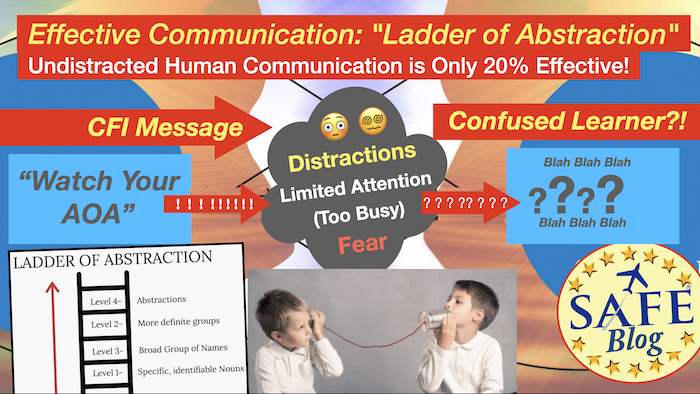
 Human verbal communication is only about 20% efficient, even in a quiet, undistracted environment. People retain only a fifth of what we say. Add the distractions and physical threats of aviation (fear) and a CFI might as well be speaking Greek. The timing and complexity of the intended message must be carefully managed in flight to achieve any success at all. Additionally, the level of abstraction is a huge obstacle to successful communication. Understanding and using the Hayakawa’s “Ladder of Abstraction” is a great help.
Aviation: Distraction and Threat
 Distractions and physical threats (fear) are both huge impediments to learning and communication in flight. The aviation environment is noisy, confusing, and often threatening to a learner. In flight, only broad concepts can be conveyed – and even these must only be attempted at carefully controlled times. “CFI chatter” is the most common error of new, inexperienced CFIs. A savvy CFI only provides “reminders” in the air of the real “teaching” done previously on the ground. “Chunking“ is an excellent CFI strategy in flight: critical ideas are only communicated clearly and concisely in the lowest distraction phases of the flight.
The more senses engaged, the greater the chance of success; “broadband!”
 To understand the optimal communication channel, visualize the worst: text or e-mail. Simple words with no body language or context are easily misinterpreted. (Emoticons were created to help). Though very effective for simple, quick data, the rated effectiveness for text and e-mail is 3-5%! This huge failure rate means not only will the message usually fail, the wrong message will probably be interpreted on the other side. OUCH! We have all done this. So what can go wrong in an undistracted environment, “broadband” environment
“Ladder of Abstraction”
 Unfortunately, “full-channel” (broadband) communication only succeeds when the sender and receiver meet at the same level of abstraction (with a shared frame of reference). The term “Ladder of Abstraction” was coined by Samuel I. Hayakawa in 1939 and provides a very useful metaphor for every CFI. As an educator formulating your message, start as simple as possible and move up the ladder to complex. Abstractions provide economy but only if you share experiences and a “frame of reference.” Otherwise, you are “speaking Greek.”
An aviation educator talking to a new learner and using terms like VFR/IFR (or all those other FAA acronyms) is only creating confusion. Film yourself and rewind that presentation (painful). Make your presentation more comprehensible to “the person on the street.” The recent PPC presentations at Oshkosh had very good rule of thumb on this subject: “How can I make this clear to a four-year-old?” This is a perfect place to start and then ascend the “Ladder of Abstraction” as the listener reveals they are actually are “getting the message.” Successful communication requires the delicate interaction between sender and receiver (“neural coupling“).
-
If you’re the kind of communicator who enjoys ideas from a bird’s eye view, try asking yourself “how” questions. These will often lead to the data, examples, and stories needed to clarify your meaning.
-
If you prefer your feet on the ground, try asking “why” questions. These help you discover the patterns, lessons, and generalizations that tie your facts together.
 A more comprehensive knowledge of your learner’s experience and world view (in a safe “Learning Zone“) allows for faster and more effective communication. If you share a familiarity with a related field, analogies can be very valuable. SCUBA diving shares many valuable parallels to aviation; careful preflight of equipment, suitable environmental risk analysis, the unforgiving forces we face for success (threats), and unforgiving physical laws that create fear in learners. Various sports share important related skills and psychological approaches that can motivate flying success. Being a curious and creative CFI makes you much more successful in conveying your message. Fly safely out there (and often)!
Check out our recent SAFE Webinar on the value of slip/skid awareness on rudder usage: SAFE YouTube
Our next SAFE Webinar is on Sept 22 on “Expanding Your Comfort Zone!”
See “SAFE SOCIAL WALL” For more Resources
 Join SAFE and get great benefits. You get 1/3 off ForeFlight and your membership supports our mission of increasing aviation safety by promoting excellence in education. Our FREE SAFE Toolkit App puts required pilot endorsements and experience requirements right on your smartphone and facilitates CFI+DPE teamwork. Our newly reformulated Mentoring Program is open to every CFI (and those working on the rating) Join our new Mentoring FaceBook Group.


Tell us what *you* think!