
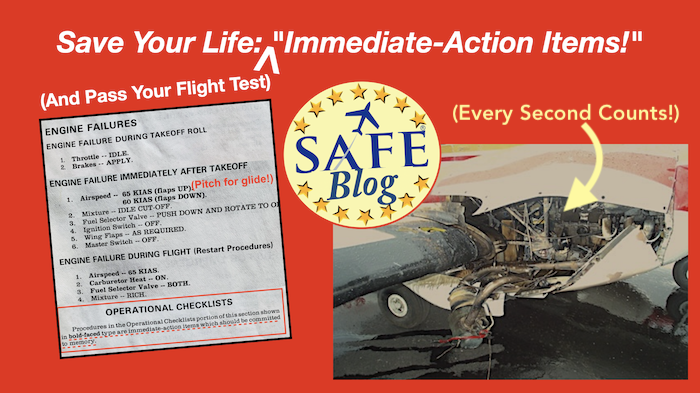
 “Immediate-Action Items” are the checklist items printed in bold-faced type. These are the first steps in emergency checklists and are required to be committed to memory by all pilots. These items are unique to every make and model airframe and a generic AFH flow is only acceptable in the absence of specific POH guidance. This also means your preflight prep. in any plane should always include a review the “boldface” items for your specific aircraft.
Certain immediate action items (such as a response to an engine failure in a critical phase of flight) are best committed to memory.
After they are accomplished, and as work load permits, the pilot can compare the action taken with a checklist…The pilot should be able to respond to immediate action items from memory and locate emergency procedures quickly…An effective training program covers these emergency procedures. Airplane Flying Handbook

This picture of my friend’s Aztec should make the “why” of “immediate action” very clear. When the right engine caught fire at 7K, there was no time to read a list. This emergency required an immediate response from memory: mixture off, fuel off, feather, get down NOW! This pilot safely landed with seconds to spare because he knew the procedure by heart and executed it perfectly. The leading edge of the wing was burned through and you could see the fuel tank and control cables directly behind.

Immediate-action items need more emphasis in the GA world, they are a religion for professional pilots. DPEs see slow and generic responses to critical flight emergencies due to poor training. For engine failures flight test applicants frequently perform the A-B-C- D generic advice from YouTube experts. This is unacceptable (and dangerous).

A successful flight test (or real-life emergency) *requires* the exact items published in the POH of the aircraft you are flying. (Watch this YouTube -ironically – for how the Payne Stewart Lear crash might have been “checklist driven”) Immediate-action items rule any professional flight deck and many of our new pilots are only a short walk away from a jet and a professional career. A careful reading of most GA piston POHs reveals the requirement for memorization of these scripts. This is not difficult, it just needs more emphasis by CFIs in training (and DPEs in testing) to execute the proper flow (rather than a generic “feel good flow”).


The ACS clearly states the need for the execution of immediate action items.

Why A-B-C-D-E Fails
Besides not conforming to the (required) FAA guidance in the aircraft POH, this generic alphabetic recitation, so popular on the internet, fails at the “B-Best field” as the second item. Pilots (especially new ones) spend so much time looking for a great field (big, into the wind, etc) that they never get to the “C-Checkist (restart procedure). This procedure should be a “flow,” performed automatically (from memory) while a pilot is achieving the best glide speed (simultaneously – no time to wait). It generally takes a few seconds to decelerate to best glide. This is the time to check the “carb. ht., switch tanks, activate the fuel pump, etc:” required “immediate action items” in your POH. Just think how many Pipers are mentioned in NTSB reports with one tank empty (selected) and one tank full of fuel (oops). Or, the mysterious Cessna in the corn field and the cause was carb. ice – not selected or too late! Remember, most trainer engines are air-cooled and if you are slow to apply carb. heat (fooling around with “B-Best Field”) you will get *No Heat* and no solution. Emergencies need to be handled “by the book.” When you get to jets, these are memorized and mandatory (21 for the Citation 500 type rating).
“Abductive” Reasoning
You probably have heard of deduction, the scientific method for the determination of truth. This takes a large body of experience, and with extensive analysis, boils it down into an absolute law. This requires time and with exhaustive research considering many carefully controlled variables. We do not have this level of certainty in our daily flying experience; this is the “scientific method.”
“Inductive reasoning,” by contrast, extrapolates truth from a small sample, and often embeds some classic cognitive biases: especially that “the future will resemble the past” and “it worked before.” Induction often operates on stereotypes and habit rather than keen observation.
Abductive reasoning is kind of a middle ground, advanced by American philosopher and logician Charles Sanders Peirce and seems to me to be a good model for aviation.
Abductive reasoning decides a course of action based on verified previous experience and the best available information. Data here is carefully gathered, but necessarily limited. Abduction always leaves the door open for the possibility of error, requiring review and reformulation: flexibility. This “soft proof” is the methodology of aeronautical decision-making. It decides the best course of action based on the constraints of time, available brain power, and the resources available. Psychologists also call this “bounded rationality.” In aviation emergencies, “the perfect” is very often the enemy of the good; we need to survive given the current resources and need to retain flexibility and vigilance. Fly safely out there (and often)!
 Airventure (OSH)24 has been added to our “SAFE Toolkit” App (free download). This App has directions to all our events and provides push notifications of all SAFE events at the show -“allow notifications!” Additionally, the toolkit is chock full of CFI resources and helpful hints for applicants in the “Checkride-Ready™” tab (DPE best advice for flight test success)


Tell us what *you* think!