
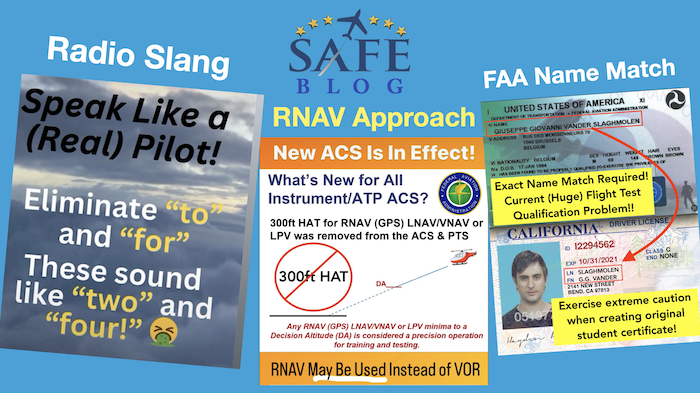
 Don’t use slang (Please 🙏)
Jargon in aviation operations is mostly harmless in less busy airspace (children at play). But when it carries over into busy airspace it creates serious problems for safety. The mystery is what motivates these mistakes. Pilots used to work hard to sound professional (not stupid) and the human urge to be “creative” may be part of it. Some of these misused terms are obviously intentional with pilots trying to sound more experienced or professional – with the opposite effect – tally-ho? But  there seems to be an increasing usage that just comes from simple bad training and ignorance. Our goal should be precision and brevity and eliminating dangerous ambiguity. I have often been delayed while a – frustrated – controller lectured a pilot on the need to read back the runway they were holding short of or landing on (required).
 Traffic calls (“report traffic in sight”) from an ATC facility answered ambiguously “I got him” etc, use up precious airtime while separation may also be compromised. Only two replies are valid “traffic in sight” and “negative contact” according to the AIM. Another basic flaw, often demonstrated even by CFIs is using “to” and “for” which are easily confused with “two” and “four.” “Roger” only means “I have received your transmission” (not “yes”). And please save “copy that” for truckers. These are common problems every pilot should work to correct to be a true professional.
Precision RNAV Approaches: 300 HAT Gone!
 The FAA has finally redefined precision approaches for both training and testing. All the FAA guidance (handbooks, ACs, etc) are being corrected to the new standard. The 300 HAT restriction to define a precision RNAV is now gone. ” A precision approach is a
standard instrument approach procedure to a published decision altitude using provided approved vertical guidance.” The 300 HAT restriction is “intentionally absent” in the newest testing standards and a further clarification was released in a YouTube from the FAA for DPEs. More official guidance is on the way.
Additionally, Appendix 3 of the new Instrument ACS contains this guidance: “The applicant may use a suitable RNAV system on conventional procedures and routes as described in the Aeronautical Information Manual (AIM) to accomplish ACS tasks on conventional approach procedures, as appropriate.” To me, this seems to eliminate the requirement for a VOR approach in a WAAS RNAV-equipped airplane.
That change is certainly going to ruffle some feathers. What happens when the GPS constellation takes a dump and we revert to Minimum Operational Network? Here again, the superior (added value) training from a superior CFI would include these (non-tested) contingencies (like MCA in private training). Just because it is not tested does not mean it should not be taught!
Exact Name Match for FAA Evaluations
 This has become an increasing problem on test day. The FAA wants an exact name match on your supplied government ID and your FAA (usually student) pilot certificate. Often the student certificate was created by a CFI and might not exactly match the government doc. This needs to be rectified *before* the flight evaluation. Usually, a driver’s license is the easiest fix at the local DMV. But “no match” on test day means “no test” (unqualified) according to the most recent FAA guidance. Fortunately, addresses can be verified with additional documents (should be residential) and only need to meet the notification requirements of the FAA under CFR 63.21 (30 days)
 Airventure (OSH)24 has been added to our “SAFE Toolkit” App (free download). This App has directions to all our events and provides push notifications of all SAFE events at the show -“allow notifications!” Additionally, the toolkit is chock full of CFI resources and helpful hints for applicants in the “Checkride-Ready™” tab (DPE best advice for success).
 Register and attend our June 23rd Webinar on “Savvy CFI Tools.” The focus will be on common problems often seen during checkrides (by DPEs) and missed in training by many newer CFIs. See “Fly Not Drive,” “Landing Magic,” and “Teaching Rudder.”


Tell us what *you* think!