
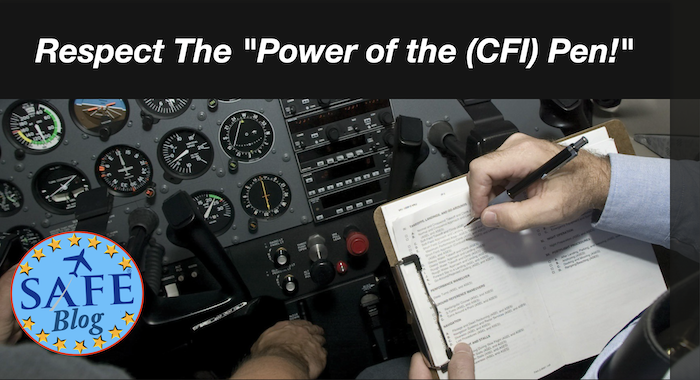
 Every CFI has an awesome power for good (or harm) in the endorsements they sign. Most pilots think a DPE is “the gatekeeper” of aviation safety with initial certification. But the CFI is really the primary influencer of aviation safety with their extensive dual given. The CFI also wields equal – or greater – legal power in their endorsements. This authority is under-appreciated by most CFIs and as a consequence, all pilots suffer (hopefully only emotionally) from under-performing pilots in our airspace. Every pilot has occasionally expressed disbelief in witnessing unsafe pilot skills or behavior. “Where did they get *their* certificate?” But under-appreciated CFI endorsements are often the loophole enabling this chaos.
 Imagine working with a lapsed pilot who has not flown in 20 years. Their FAA certificate does not expire, though their skills might totally disappear over time. After acquiring a new medical, the only requirement to legally pilot again is the endorsement (and minimal required training in 61.56) from a CFI. The CFI here has much more legal power than a DPE testing a well-trained applicant. All future safety depends on the integrity and high standards of the CFI. The flight review in this example is much more influential (and hopefully time-consuming) than a flight test.
 Learners applying for an initial rating or certificate study extensively and pass a recent knowledge test before meeting a DPE. They are also thoroughly trained and pre-approved before their evaluation. By contrast, a lapsed pilot may have forgotten everything and often shows up expecting rapid success (more magical thinking). This psychological expectation can be and important obstacle to success.
A good CFI with command authority will honestly define the necessary training for a lapsed pilot and control their expectations. The FAA document on flight reviews is very clear on this topic. Inadequate flight reviews are probably the biggest “safety gap” in aviation safety. My rule of thumb has always been an hour of training is usually required for every 2 years of inactivity (but of course this varies wildly). Getting your client’s “buy-in” is obviously critical to the success of this training. If I hear “It’s like riding a bicycle,” we are in deeper water.
Endorsements For Applicants Testing
 A previous blog mentioned the 20% “failure to qualify” for applicants meeting their examiners for an evaluation. Since this was published and with the help of SAFE’s “Al-In-One” pdfs (FREE) the rate has dropped dramatically from the inferential data online. This is obviously beneficial for both the DPE and the applicant. Most DPEs require pre-verification of endorsements and experience now. But the more important component is to ensure the CFI has thoroughly prepared the applicant to be successful (they have fully “earned their endorsement”). Dragging in with a 72% on the knowledge test really starts the process off badly. Every DPE is required to retest all these unsuccessful knowledge items. They are going to ask about all those items and probe much more deeply than the FAA’s “A-B-C” multiple choice exam. Getting it right the first time (on the knowledge test) is a much better plan. A recent applicant had a 72% with an obvious error trend in aerodynamics, esp. AOA, slow flight and stalls. Guess what – we have to ask all about that on the oral!
So every candidate should study hard to obtain the highest score possible on the knowledge test and be thoroughly trained on the deficiencies. It also helps greatly to practice verbalizing the explanations you will be delivering to the DPE. Fly safely out there (and often)!
 Visit SAFE in the Bravo hangar #82/3 at Sun N’ Fun (April 9-14) and join our spring sweepstakes for a Lightspeed Delta Zulu, Aerox 2-Place O2 system, and other great prizes (join, upgrade, or donate $15)! Come join our SAFE “CFI-Roundup” on Saturday at 16:00 in the Prop 75 building (right by the exhibit hangars). Free ice cream is offered to incentivize participation (and aid educational retention).


Tell us what *you* think!