
The “Fundamentals of Instruction” (FOI), are required to be learned and then tested by the FAA for initial CFI certification. This teaching doctrine is a formidable challenge for many pilots transitioning into their new role as “educators.” Success for every aspiring CFI requires shifting from the world of “flying and physics” to their new primary role as “coach and educator.” And the educator role requires more psychology than physics. Some of this training does more harm than good and perhaps some updating is advisable?
But the FAA FOI is only a starter kit for a serious aviation educator (more). At the heart of the FOI are six “laws of learning” derived from Edward Thorndike’s behaviorist  experiments (good dog, bad dog) from over 100 years ago. This is like operating at the “J-3 PPL” level in a world of “glass-panel GPS.” Modern cognitive psychology and neurological testing have discovered many more efficient tools and techniques than the original FAA “laws of learning” from the late 1800s. These new techniques make the educator’s job, and a learner’s progress, much more successful and also help eliminate many proven educational fallacies.
To more effectively educate aviators, I propose a seventh law of learning that leverages the traditional “FAA Laws” while also adding some benefit from newer cognitive science. This cognitive focus modifies all the previous FAA “Laws” by also providing a “learner-centric” focus.
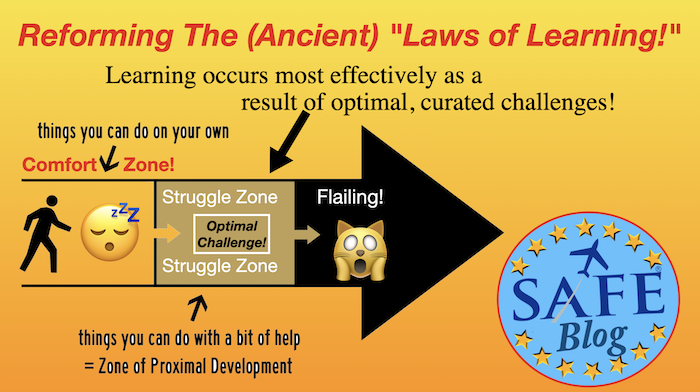
Law #7: Learning occurs most effectively as a result of optimal, curated challenges – remembering that every learner is unique and central to the educational process!
 This law encompasses the central premise of the Talent Code, by Daniel Coyle. “Talent” is not inborn, it is grown with “deep practice.” Coyle provides scientific evidence that learning is best achieved by training with “optimal challenge” between “comfort” and “flailing.” Initial learning is largely drill and repetition (not scenario-based) with errors and self-correction. “Exploration teaching” – scenarios without careful guidance – have proven to be expensive, wasted time for learners. “Guided discovery” happens only when basic skills are mastered and appropriate challenges are presented in a timely fashion.
 These neurological ideas were originally proposed by Lev Vygotsky and later Donald Hebb who developed these learning theories based on neurology and verified results. Their ideas have been further tested with modern MRIs and scientific studies bolstering modern teaching techniques. This new learning law also puts the student at the center of the educational process – the most important actor in the educational equation. If the student has not learned, in the majority of cases, the CFI has failed to motivate or teach adequately; a more honest and equitable educational relationship.

Achieving “optimal challenge” is similar to building muscle mass in the gym, where there is little benefit to endless easy reps (patterns?) in the “Comfort Zone.” Real progress requires practice  at the edge of current capabilities to stimulate growth and improvement. In neurological development (learning) aviation requires careful coaching from a knowledgeable educator to safely present this “optimal challenge.” Daniel Coyle in the Talent Code calls this “deep practice.” You must be willing to try and struggle, fail then improve. The ultimate benefit is more rapid, enduring results. (Listen to this audio summary). A huge impediment to learning is self-image and fear of failure. By definition, if you only do what you already know, the learning of new skills is impossible.
 This learning theory is neurologically validated by the documented “myelination” of new brain circuits we engage when working with “optimal challenge.” The brain is an amazing machine, and myelinated neurons, basically neurons with extra insulation, operate 300X faster when transmitting data – broadband compared to dial-up. The effectiveness of this teaching method is also proven by the dramatic performance increases documented across a whole range of disciplines from tennis to soccer to musical performance.
 The magic key to this whole process is a savvy CFI providing “optimal challenge” to the student. Learning well is a very personal experience and success requires a trusted honest relationship. The CFI must carefully balance progress and challenge as a lesson progresses. Rote application of standard lesson plans on a pre-determined schedule is damaging to the educational process (and unfortunately common).
A learner only benefits from new experiences when they have achieved and retained the previously presented foundational skills (that “readiness law”). This is called “incremental mastery” and the basis of the “building block theory” in education. Accelerated programs often push too rapidly and create confusion and fear rather than learning. Our educational objective is to create enduring skill acquisition while simultaneously building learner motivation and confidence. The result is skillful, safe pilots demonstrating “command authority” (PIC) and resilience. Fly safely out there (and often)!
See “SAFE SOCIAL WALL” For more Resources
 Join SAFE and get great benefits. You get 1/3 off ForeFlight and your membership supports our mission of increasing aviation safety by promoting excellence in education. Our FREE SAFE Toolkit App puts required pilot endorsements and experience requirements right on your smartphone and facilitates CFI+DPE teamwork. Our newly reformulated Mentoring Program is open to every CFI (and those working on the rating) Join our new Mentoring FaceBook Group.


Tell us what *you* think!