
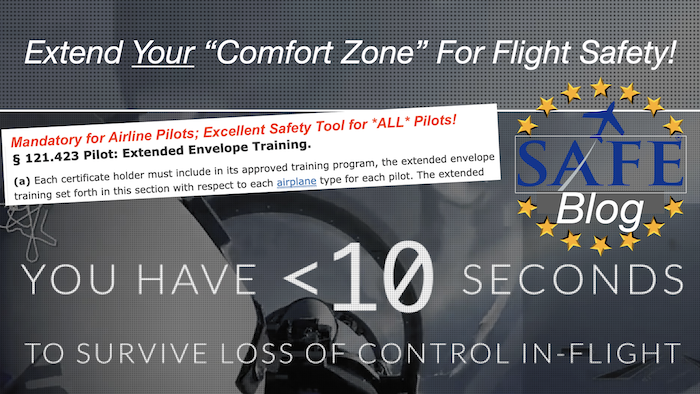
 The amazing lack of understanding of slip/skid/spin aerodynamics demonstrated by many applicants on flight tests is almost criminal. A simple rote recitation of “P-A-R-E” with no real understanding or experience is not going to save a pilot in an upset situation. Yet Loss of Control-Inflight (LOC-I) is the #1 fatal accident causal factor in aviation. Pilots who have not experienced flight in this area of the flight envelope will suffer from “startle” and lock-up on the controls when they are forced out of their “comfort zone” by surprise circumstances.
 The SAFE Extended Envelope Training moves a pilot sequentially (and comfortably) into the corners of the flight envelope and creates greater skill, confidence, and safety. This training is accomplished in a normal category airplane at your local airport. It builds great skills and is a preliminary step toward full UPRT courses like APS utilizing aerobatic airplanes.
LOC-I is generally defined as an adverse flight condition that has placed an airplane outside of the normal flight envelope with a potential inability of the pilot to control the airplane using traditional pilot skills. Aviation Performance Solutions

It is not just new pilots that demonstrate this deficit in skill and knowledge. The “comfort zone” grows increasingly smaller with years of flying. Most experienced aviators have not done a comprehensive stall series in years, avoiding any full-control maneuvers with great fear (failure in Flight Review). Consequently, these skills will be unavailable when required for upset survival. It takes a skillful and compassionate aviation educator to move a fearful pilot to the edges of the flight envelope. There must be trust and motivation on the part of the pilot to make this training successful.
Equipped with only the skills gained from normal licensing training, a pilot may be unable to cope in this environment. Delayed reaction, fear, panic, combined with an inability to correctly interpret foreign visual and other sensory cues, and a lack of the skill set required to correctly apply counterintuitive control inputs for safe recovery within this critical window, may all prevent an ill-prepared pilot from surviving an upset. Aviation Performance Solutions
 Currently, most applicants on flight tests can barely accomplish a full stall without trembling (and they have been recently trained). Since LOC-I is the #1 cause of fatal accidents that usually end up in a stall/spin descent to a crash, more training is necessary here for *ALL* pilots to assure comfort, competence, and safety.
 Much of this fear and timidity can be traced back to FAA SAFO 16010 and “watered-down” flight training. This document guides the ACS and requires flight test applicants to be evaluated at speeds above the stall warning activation. Since minimum controllable airspeed is no longer tested, most aviation educators are no longer *teaching* this area of the flight envelope either. COnsequently, many new pilots are terrified of full stalls and have never seen a turning stall or a ballistic recovery. This failure in flight training is killing pilots every day through increased timidity and lack of basic skills.
 SAFE has long advocated “Extended Envelope Training” for all pilots to develop comfort and competence beyond the everyday “comfort zone” of daily flying. Pilots without surplus skill and knowledge capability will be the victims of LOC-I when forced out of their smaller world by turbulence, weather or other precipitators of upset. The SAFE EET training syllabus can be used as a single training event for more proficient pilots or sequentially for less confident and competent pilots to increase their skills. EET is also an excellent “bridge” between commercial pilot competence and aerobatic aspirations. Learn to use the controls to their full operating limits and coordinate the rudder in all flight attitudes.

Another training intended to create full-envelope comfort and competence is the training performed to satisfy the initial CFI spin endorsement. Unfortunately, most of these endorsements are perfunctory, with very little substantive ground or flight training. AC 61.67C (Chg 2) provides very detailed and specific guidance on what should be accomplished during an initial CFI spin endorsement. CFI spin training is seldom done completely or correctly. We need CFIs who are both well-trained and comfortable in full-envelope training and also compassionate enough to lead other pilots successfully into full-envelope competency or we will never make a real dent in our accident statistics.
 We recently had a grieving father of a young CFI contact us. His daughter died while teaching stalls in a large flight academy. A SAFE poll of CFIs revealed that a shocking 65% of CFIs, at some point, had to physically take control from a student who “locked up” on the flight controls. That is an astonishing frequency of student “fear paralysis” during training. Techniques to counter this kind of (avoidable) fear are seldom taught to flight instructors.
 Fear, startle and lock-up do not only affect pilots, it is a threat to instructors who may not be fully prepared to handle these situations. Every flight training professional should take a quality upset training course, and every pilot should train fully in the slow flight/stall area to be comfortable and capable. That is what a flight review should include (at a minimum) Train the killers… Fly safely out there (and often)!

See “SAFE SOCIAL WALL” For more Resources
 Join SAFE and get great benefits. You get 1/3 off ForeFlight and your membership supports our mission of increasing aviation safety by promoting excellence in education. Our FREE SAFE Toolkit App puts required pilot endorsements and experience requirements right on your smartphone and facilitates CFI+DPE teamwork. Our newly reformulated Mentoring Program is open to every CFI (and those working on the rating) Join our new Mentoring FaceBook Group.


Tell us what *you* think!