
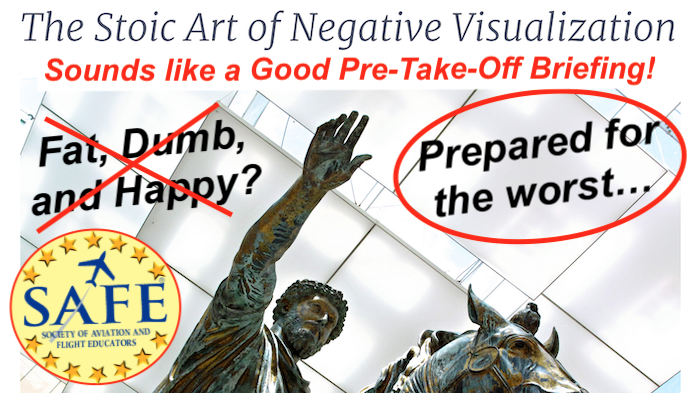
 We need to be mentally prepared when we go flying. Aviation is what industrial analysts call a “high consequence area.” The consequences of even a small slip-up can be huge! Our human defense to these exposures – so we can fly another day – is to convince ourselves that this must be “the other guy” not me! But truly this can happen to all of us. Unless we make it personal, these cautions will not succeed. We need to be vigilant and fully aware when we go flying (not “fat, dumb, and happy”) We need to understand the internal failure process that causes these failures and how we can occasionally be guilty of this erroneous thinking.
 The optimism bias is built into all humans. We think we will be luckier than our peers or there would be no state lotteries, no start-up businesses (85% fail) and we all would be saving for retirement (instead of buying planes). Tali Sharot wrote a great book – The Optimism Bias: A Tour of the Irrationally Positive Brain – examining every side of this interesting phenomenon. It got us out of the trees millions of years ago and still propels human effort and achievement. (And pilots seem to have a bigger dose of this tonic)
We humans also commonly exhibit a sense of superiority – not necessarily arrogance -but 90% of drivers say they are “above average” and the superiority bias has been replicated in every human endeavor. And pilots are not the steely-eyed rational thinkers we seem, but driven (like everyone else) by emotional motivations- that “mission mentality”? – and we often fall prey to “magical thinking.” How else would someone believe they could “stretch fuel” or fly through severe icing in a piston plane? We are dreamers who buy more planes than we can afford (or fly) and then occasionally try too hard to succeed. When you combine our built-in optimism with over-confidence and confirmation bias, you have a toxic built-in mindset we need to monitor carefully and work to control (the most complex airspace is between our ears?)
The best antidote for this misplaced optimism might be the ancient Greek Stoic Philosophy and the process of negative visualization – they call it the “premeditation of evils”. Used by warriors marching into battle, this approach is modeled nicely in a good pre-takeoff briefing. The idea is to realistically visualize and prepare for all the possible terrible outcomes before we go flying (instead of wearing the rose-colored glasses); “On the take-off before rotation, if I have any problem – fire, loss of control, or any surprising noise or malfunction – I will reduce the power, maintain the centerline and stop” Adding more detail and realism is even better; “if an engine fails before rotation, I will reduce power and stay on the runway…” and creates caution and readiness for action. This process requires us to be totally present, fully aware – what shooters call “condition yellow“. Surely this is not a rosy, happy picture, but it is not intended to be. A stoic is realistically placing all the risks on the table for an honest evaluation. Too much optimism is can easily harm us.
 “Personal minimums” applied to every area of flight are also the same “premeditation of evils” when evaluating enroute weather and changing circumstances. “If the ceiling is below 3,000 agl and I am VFR only, I will turn around and land…” But the essential commitment that makes this process work is honesty, discipline and clearly imagining how terrible the outcome would be in a very personal setting. It would really suck to be in the hospital for three months and then walk with a limp for the rest of my life…or not come home at all.
I certainly don’t want to diminish anyone’s joy of flying with these recommendations, but we have to be honest about our job as pilots since the very real price is our life and those of our friends and family. And especially when teaching, honesty and careful modeling of risk management are essential. Clearly, bad stuff happens too often in aviation and we have to pay attention.
The same human adaptation which normalizes risk can also diminish our healthy respect (and occasional fear) for the dangers of flight. Did you ever have a moment of clarity at altitude flying cross-country in the middle of the night and realize how bold some of this flying really is? With no appreciation for risk we can quickly become complacent and thus vulnerable. Fly as if your life depends on your success and both your skills and presence of mind will improve. It is essential to stay situationally aware of and protect yourself from importing too much optimism into our flight decisions. Fly safely (and often) out there!

Join SAFE to support our safety mission of generating aviation excellence in teaching and flying. Our amazing member benefits pay back your contribution (like 1/3 off your annual ForeFlight subscription)! Our FREE SAFE Toolkit App puts required pilot endorsements and experience requirements right on your smartphone and facilitates CFI+DPE teamwork. Our CFI insurance was developed specifically for CFI professionals (and is the best value in the business).


Tell us what *you* think!