
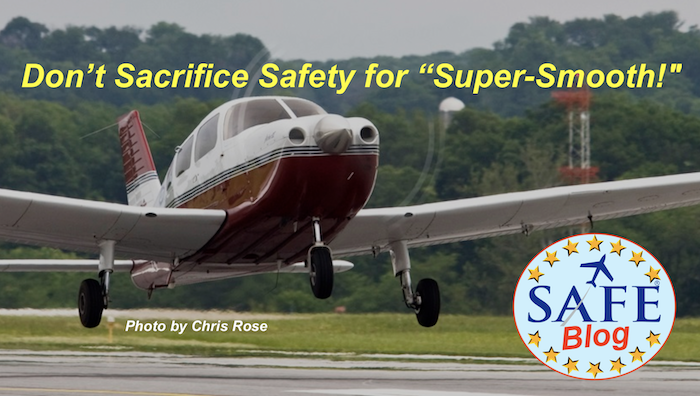
 I remember distinctly discovering the secret of obtaining a super-smooth landing in a PA-28; just carry extra speed and “drive it on.” Eliminating the flare made landing amazingly simple – why had my CFI not figured this out? This occurred during the solo cross country phase of my flight training (50 years ago) after suffering through the usual first solo commands – “hold it off, don’t let it land!” Needless to say, my instructor disagreed with my new “smooth landing” technique and righteously explained, that a smooth landing was not the objective, safety was. Extra energy on touchdown and the three-point attitude were, he said, an invitation to disaster (something about square root functions and porpoising). The #1 accident in a jet is an overrun, sometimes from trying to “grease it on” with extra speed in the flare.
You may be surprised to learn that “smooth touchdown” is nowhere to be found in the FAA test standards (the closest is “minimum sink rate” in the soft field section). The more important objectives of a good landing are clearly described: an accurate touch down on the centerline (aligned with no lateral drift) and properly configured and stabilized. Also, arrive as slow as possible touching in the “landing configuration.” For a pilot, “smooth” is a reward, but not the sine qua non. Make your landings proper and safe first and after some practice, “smooth” will be easily achievable. Many smooth landings are actually not safe at all.
But of course, it’s the *passengers* who disagree. The *only* tangible non-pilot standard to judge piloting skill is a super-smooth touchdown. Pilots really need to push back here and get over this imposed illusion for the sake of safety! Smooth landings can often involve extra speed and improper technique. It is much safer to stabilize, control the centerline and land in the proper attitude, even if it touches with a little bump.
 The “smooth landing mandate” naturally carries onward into professional jet operations – something about “primacy?” We all want to be the “hero pilot,” and it’s easy to consume a mile of runway milking the last few feet to touchdown in search of the “super-smooth” arrival. You will indeed impress their clients in back when you run off the end of the runway? Not surprisingly, overruns on landing are the #1 cause of accidents in turbine aircraft.
Whether trying to minimize the “bump” felt by passengers or lulled by landing often on runways much longer than needed, business aviators tend to carry excess speed and float into long landings. The average business jet touch down point is about 1,600 feet from the threshold, and nearly 20 percent touch down beyond 2,000 feet, well past the aim point that is the basis for predicted aircraft landing performance
Admittedly, there are a variety of causes of overruns in turbine landings, most notably the extreme weight and energy at play and contaminated surfaces. But ironically, the solution to hydroplaning is actually a “firm touchdown” to create positive contact with the runway surface.
And to be very clear, I am not condoning (or recommending) hard landings. I am just advocating for less of a focus on “super-soft” touchdowns as an end in themselves. Go for “safe” first (as described above) and smooth will follow after some practice. Fly safely out there (and often)!
 Join SAFE and enjoy great benefits (like 1/3 off ForeFlight)! Your membership supports our mission of increasing aviation safety by promoting excellence in education. Our FREE SAFE Toolkit App puts all required pilot endorsements and experience requirements right on your smartphone and facilitates CFI+DPE teamwork. Our SAFE CFI insurance was developed by SAFE specifically for CFIs (and is the best value in the business). #flySAFE


Tell us what *you* think!