
The Dunning-Kruger Effect is often misunderstood to apply exclusively to low intelligence; “too dumb to know you are dumb.” But Dunning-Kruger applies across the spectrum of human intelligence and actually describes a lack of self-awareness or metacognition that blinds individuals at every level to their real abilities. Very simply, we are unaware of our incompetence – you don’t know what you don’t know!
In essence, we argue that the skills that engender competence in a particular domain are often the very same skills necessary to evaluate competence in that domain—one’s own or anyone else’s. Because of this, incompetent individuals lack what cognitive psychologists variously term metacognition.
In fact, very intelligent people are often the most guilty of overrating their own skills – especially in a field outside their “privileged domain.” Success and competence are “domain-dependent” but successful people have a hard time being humble and admitting instead; “I initially suck here.”
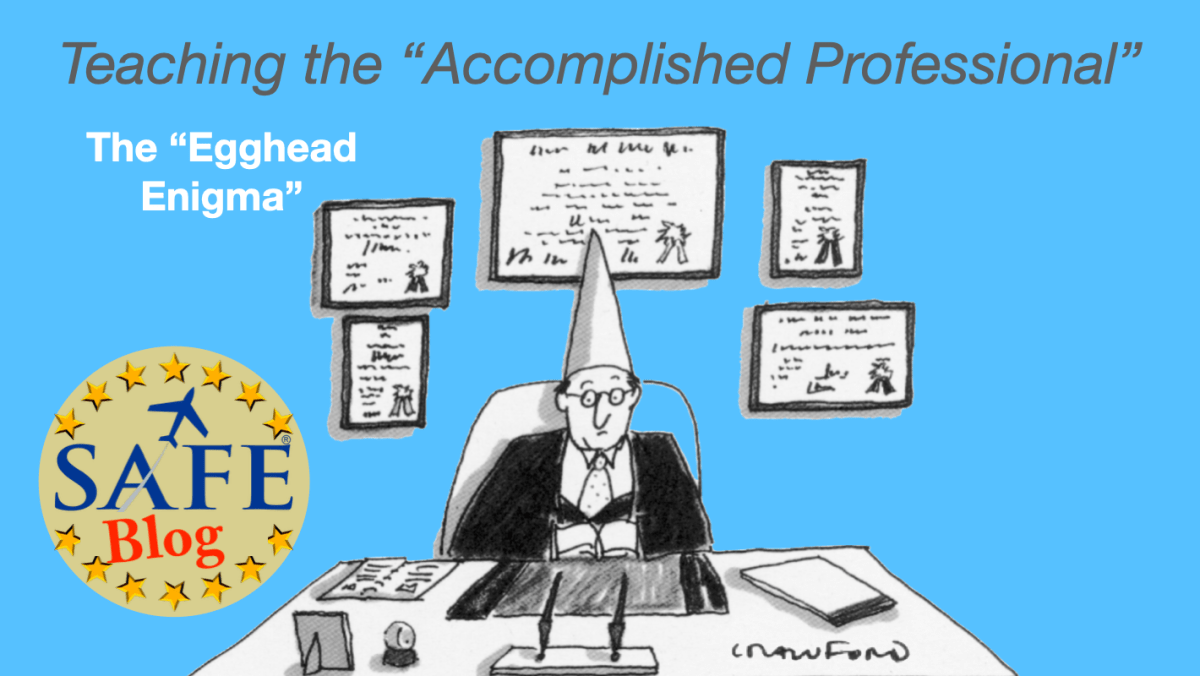
For the aviation educator, there is an additional problem here; highly intelligent people are usually the very *worst* students since they may never have experienced struggle or setback during their climb to success. My personally coded term for this problem is the “egghead enigma;” smart, accomplished people who inappropriately import a sense of competence in flying despite obvious ineptitude.
 Chris Argyris documented this problem (and offered some clever solutions) in this book. People blessed with high intelligence often achieve success with less effort and struggle and thus never become good at being a student. Accomplished professionals in one field also often inappropriately transfer their sense of competence (and even exceptionalism) to a field where they are really only a beginner (e.g. a highly accomplished academic or business person taking up flying). Add some arrogance and these become the most painful people to try to teach; an overbearing “know it all.” They show up for Lesson #1 ready to tell you exactly how to teach the lesson. Young CFIs can often get “bulldozed” by these controlling, self-important “learners.”
As experience and hours pile up this problem may get worse, not better; success becomes an impediment to further learning. This is a well-known problem in the “C-suite” of business too. Read Teaching Smart People How to Learn by Chris Argyris (a Harvard Business Review Classic) for a great analysis of this problem. Experts and professionals are remarkably bad at learning.
Put simply, because many professionals are almost always successful at what they do, they rarely experience failure. And because they have rarely failed, they have never learned how to learn from failure. So whenever their single-loop learning strategies go wrong, they become defensive, screen out criticism, and put the “blame” on anyone and everyone but themselves. In short, their ability to learn shuts down precisely at the moment they need it the most. [previous blog]
Confidence is a valuable evolutionary trait that keeps us humans forging ahead and accomplishing amazing things on the cultural level. But *overconfidence* leads to a lot of many fatal accidents in mechanized devices. We need to recognize this hazard in flight training and manage it during every preflight assessment. I-M-S-A-F-E-(C)?
 Overconfidence and the often associated arrogance is not specifically recognized as a “hazardous attitude,” by the FAA but obviously is associated with invulnerability and macho (and is also well represented in our pilot population). Calibrating our confidence is critical in every pre-flight self-assessment. Pilots do some crazy things in planes and seem to just believe/hope it will work out – hope is never a good planning strategy! Every aviation educator should be alert for overconfidence in their students, it is a sure killer.
Every honest CFI must carefully protect aviation in general and their personal liability, by shutting down these “bulldozers.” If any person is not acquiring appropriate skill/knowledge and judgment, they must not be allowed to advance and continue (our industry is full of this improper attainment). Aviation accident statistics are littered with very smart, very professional people who (unfortunately) never learned to fly well and lacked proper the proper self-knowledge and restraint to be safe (classic Dunning-Kruger) These people are well represented in Dr. Bill Rhodes “Scary Pilots Powerpoint.” Fly safely out there (and often)!
 Join SAFE to support our safety mission of generating aviation excellence in teaching and flying. Our amazing member benefits pay back your contribution (1/3 off your ForeFlight subscription)! Our FREE SAFE Toolkit App puts required pilot endorsements and experience requirements right on your smartphone and facilitates CFI+DPE teamwork. Our CFI insurance was developed by SAFE specifically for CFIs (and is the best value in the business).


Tell us what *you* think!