
During any emergency, luck certainly plays a role, but positive pilot action is the essential ingredient for success. Being alert and vigilant – having prebriefed the possible failure modes – enables successful performance by preventing panic. Psychologists call this “priming,” a mental rehearsal of all possibilities and a state of readiness. This prevents “startle” from incapacitating the pilot. Considering all the possible outcomes *before* beginning any flight helps ensure a correct and rapid response. And during a dual flight, the CFI carries a lot of this responsibility. They are both the educator, but also (to varying degrees) in charge of safety and survival. Every CFI needs to be ready to handle the surprises illustrated below.
Here are two very similar accidents that highlight how essential CFI vigilance and proper action can be when an emergency occurs. Some details are unknown and I am not judging here. Please take a look and click on each to dig into the NTSB details. When things go bad, we will be put to the test. Being ready – primed and vigilant – usually determines the critical difference in the outcome.


“Priming” is the reason we do pre-takeoff briefings, it is the stoic attitude that assumes “things *will* go wrong. A pre-planned, fluid response should be briefed and ready to go (Code Yellow). Surprise and panic will cause startle and inappropriate action since our genetically programmed response seems to be to “pull away from the ground.” When power fails we need to be spring-loaded to “unload” (the “big push”) and keep the wings flying. Whatever we have available to us after that is better than spinning in out of control.
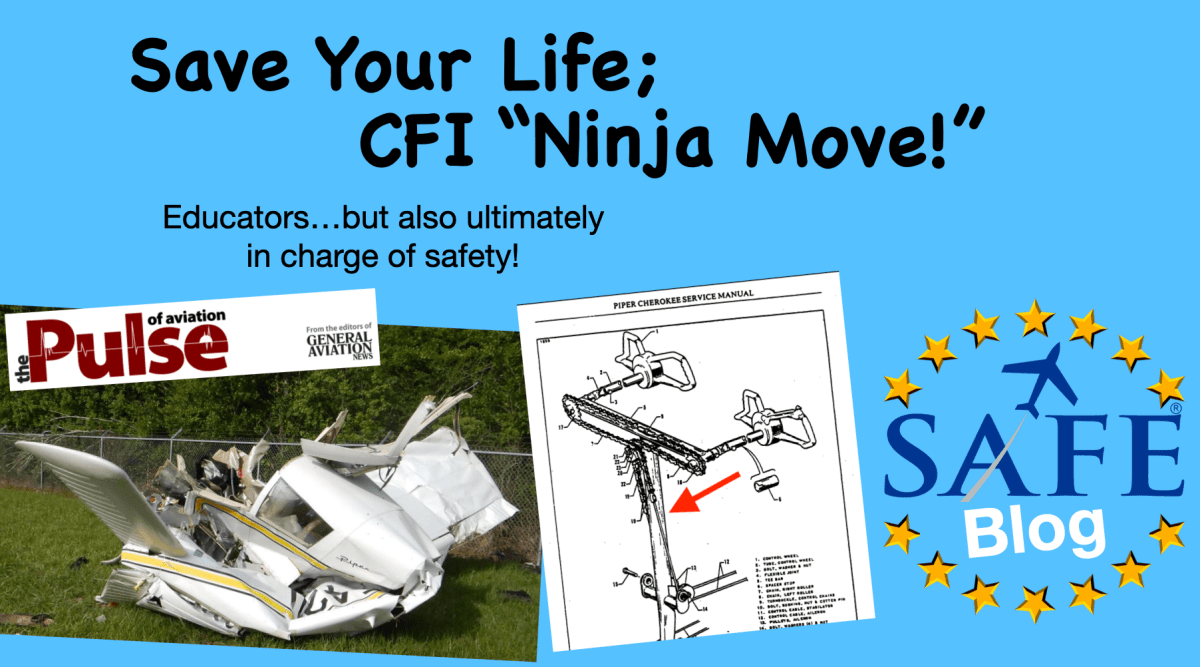
 The fatal accident here was dual and it is entirely possible that the fairly experienced female CFI was overpowered by a panicking client (the size disparity is not clear from the documentation). Briefing emergencies (and priming) with the learner helps prevent panic in an emergency (as does a trusting relationship). But if survival becomes a “fight on the controls,” in an emergency, the CFI has to do whatever is necessary to regain control. A trick available to CFIs in most trainers is to use your foot (and the greater power of your leg) on the crossbar under the panel to force the yoke forward and reduce the angle of attack. I have twice overpowered a panicking student over-rotating the pitch (in a Cessna) by easing down the nose forcibly with my foot. When “discussion” fails, positive action is required. It is wise to practice this “CFI trick” and be ready.
"On take-off in a C-152, a student on a 'Discovery Flight' with 'long ago experience' kept pulling and over-rotated the nose (going incoherent and babbling as he pulled). The plane was beginning to mush at a couple hundred feet with the stall horn activating. I thought to myself 'this is how we die.'

After verbally commanding a release and attempting to force down the nose with both arms, I put my foot on the control bar below the panel and eased down the pitch attitude while talking calmly to him. Once the horizon came back into view he became more reasonable and we continued the flight (practicing the 'exchange of controls' a few times...)"
SAFE is reviewing all accidents presented in the General Aviation News and offering suggestions to enable safer flying. (Subscribe here). Wishing you all happier flying than this! Get out on these beautiful spring days and enjoy some relief from the pandemic and winter weather – before the heat hits down south! See you at AirVenture in July; fly safely (and often)!
Join SAFE now and win a new Lightspeed Zulu Headset, a Sporty’s handheld radio, an Aerox PrO2 oxygen system! Every new membership, renewal or Step-Up or donation (tax deductible) through May 15th, will enter you into the spring member sweepstakes for amazing prizes.


Tell us what *you* think!