

In everyday flying, most pilots value a predictable, controlled flight (we are not talking about thrill-seeking “flying cowboy” stuff here). When you put the chocks on the wheels and there have been no “surprises” we usually succeeded in our mission. One flight last fall was notably different though, involving a wake turbulence encounter at 16K deadheading into Chicago Executive.
This unannounced, surprise encounter rolled our jet 70 degrees to the left and put us 20 degrees nose down (with a view of just Lake Michigan) in only a second or two with all the lights and alarms. The negative G force totally trashed the cabin (if there had been unbelted pax in back they would have been severely injured). The 20lb pilot handbook on my left even became airborne and bruised my legs when it ended up in my lap. Fortunately, automatic training took over and standard “power to idle, roll wings level” restored normal flight (we lost 1200 feet and were going rapidly to over-speed – sorry to ATC!)
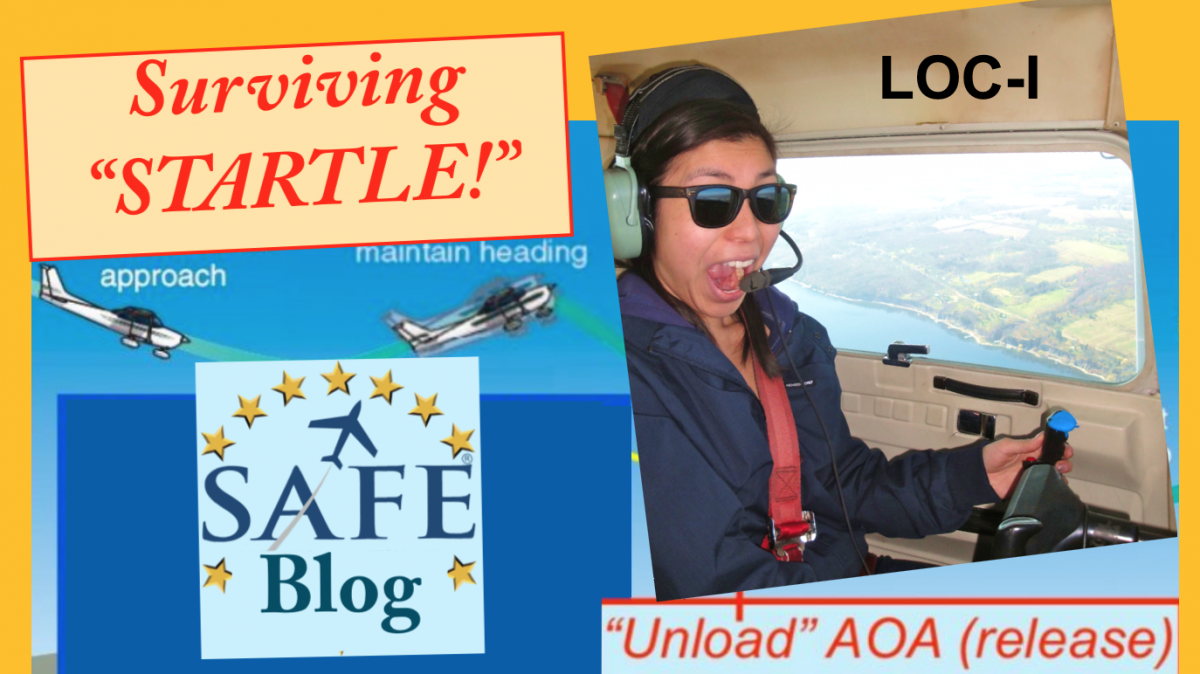
 This incident gave me an “up close and personal” experience with the “startle response” and how these events can happen anywhere/anytime to even the most careful and prepared pilots. Startle can originate from any sudden upset (weather, wake, mechanical) when the pilot experiences sudden G force (especially negative) or loss of normal horizon orientation. It can hit any pilot unexpectedly during any day of “normal flying.” These disabling experiences are often implicated in Loss of Control-Inflight accidents (the number one causal factor in pilot fatalities). Unfortunately, a casual reading by the fireside cannot do justice to – or prepare us for – this extreme visceral experience. A sudden startle can disable our ordinary operating system in a second. The critical question for safety is “how can we assure an antidote or inoculation to startle?”
 SAFE has developed the “Envelope Extension Training” syllabus for CFIs, and we know there is great value in “fear inoculation” and experiencing extended envelope flight attitudes regularly. Part 121 regulations now require airline pilots to practice “envelope extension” regularly. And though I have flown all these maneuvers often and even some aerobatics in the past, I wanted to go beyond what a normal category airplane could supply. I headed down to Patty Wagstaff’s aerobatic school in St. Augustine a week ago to extend my envelope even further with an Upset Prevention and Recovery course (UPRT). What a fun and amazingly useful experience this was!
 Allan Moore, the chief instructor at Patty’s school is an amazing educator with years of aerobatic and upset teaching experience. We spent an hour exploring their understanding of startle/upset and the prevention techniques they have developed (and teach) for “desensitizing” pilots. After a couple of hours in the Super Decathalon with Alan, I can attest to the value of their recovery formula: “Look-Unload-Roll-Recover.” Upset Prevention and Recovery really works. (See more in SAFE Resources)
One continuing enigma in aviation safety is the fact that though all part 23 and 25 aircraft are, by regulation, designed “nose heavy” to recover stability by pitching down in response to an excessive AOA (stall or loss of lift), humans predictably overpower this safety design by pulling back when encountering a stall creating most of the problems.
“STARTLE FACTOR – CLUTCH REFLEX:
The answer is simple, we are all Human! As humans we have walked around on earth for a long time at 1 G. None of us like to fall down, when we do fall, we always clutch or brace ourselves, falling induces a sensation of less than 1 G. Take an infant moments old, subjected to a slight down motion causes them to startle and cry. This is called the moro reflex, and while its called “startle factor” or “clutch reflex” in an adult, the reflex remains with us our entire life. By the way, there is no crying in stunt flying! With proper de-sensitivity training to the 1/2 G experienced during a stall I believe we could almost eliminate the occurrence of spin accidents.
It is the startle factor (clutch reflex) that is responsible for taking an airplane that has been initially upset and turning it into a spin. The involuntary clutch reflex on the yoke as the airplane is pitching down stalls the wing even more. Additionally, if there is any roll motion the pilot will involuntarily deflect the ailerons to raise the low wing, inducing adverse yaw and drag and stalling the wing deeper on the aileron that is deflected down.” Allan Moore
Though startle is covered in a recent GAJSC startle handout, and there are many articles written on the subject, reading alone will not create inoculation. You must fly and experience and actual negative G force and resulting disorientation. It is essential to feel your body’s ancient, visceral reaction to this experience to understand it fully. “Startle effect” can render any pilot helpless and incapable of effective action without some previous and recent experience (see a comprehensive analysis here). This surprise bodily reaction and loss of cognitive bandwidth from the fear and adrenaline is shocking.
 I recommend every pilot prepare for “startle” by finding an experienced instructor and “extending their envelope” with some “old school” maneuvers found in our “SAFE Envelope Extension” course (covered more fully in the upcoming CFI-PRO™ Workshop at Sporty’s). I also highly recommend every pilot also continue this learning with a UPRT course at a high-quality school like Patty’s or the well-known APS courses. (Patty also has a new video course on aerobatic training just out at Sporty’s Pilot shop) Extended Envelope and UPRT will open your eyes and make you safer when an unexpected “startle” slams you during an “ordinary day in the cockpit!” Fly safe out there (and often!)

SAFE CFI-PRO™ workshop is open to every aviation educator at every level (even if you are working on your CFI?) June10/11 at Sporty’s Pilot Shop.
Join SAFE to support our safety mission of generating aviation excellence in teaching and flying. Our amazing member benefits pay back your contribution (1/3 off your ForeFlight subscription)! Our FREE SAFE Toolkit App puts required pilot endorsements and experience requirements right on your smartphone and facilitates CFI+DPE teamwork. Our CFI insurance was developed by SAFE specifically for CFIs (and is the best value in the business).


Tell us what *you* think!