
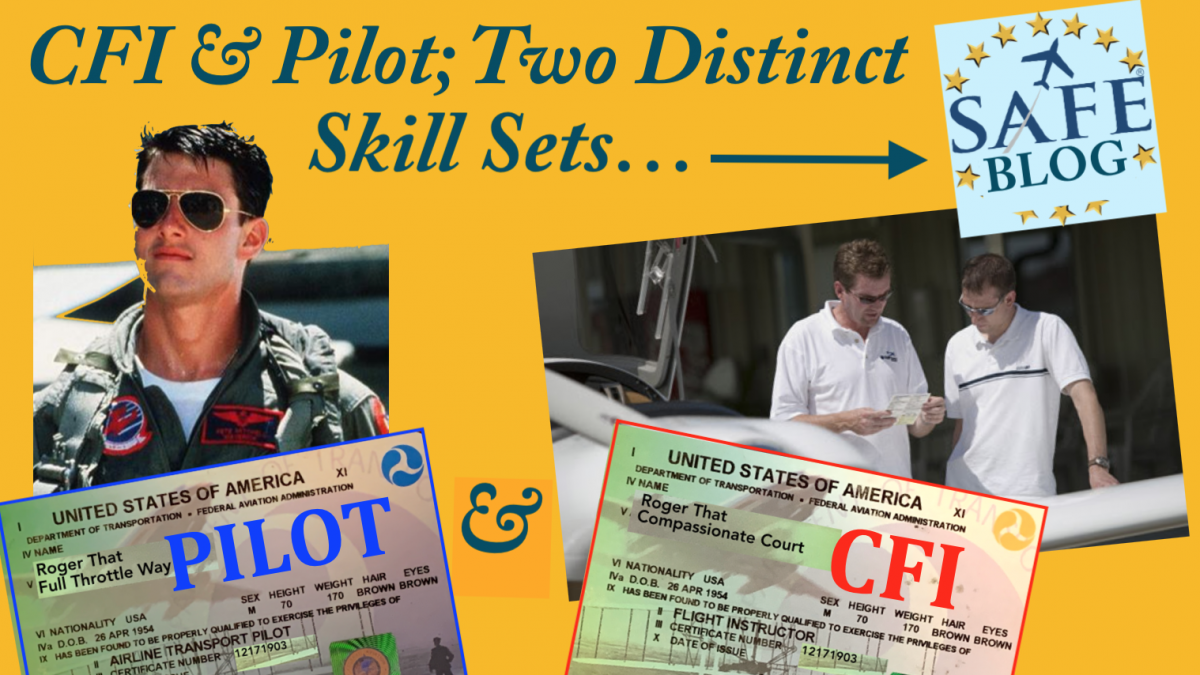
If you are an approved FAA educator, you carry two very different pieces of FAA plastic on board every flight. Each certificate requires a very different approach and a unique set of skills to be successful. With the pilot certificate, you are driving the plane and seeking precise control and efficiency. The pilot certificate requires assertiveness and confidence – fast action and intolerance of error; these are airplane challenges.
The aviation educator role requires a different skill set patience and compassion. A good CFI is not doing the flying – the learner should be handling the controls and the radio. A CFI-PRO™ allows their pilot-in-training to explore and self-correct – and their flying is quite honestly often pretty sloppy at first!
For any precise pilot, teaching flying can initially be quite painful. It’s sloppy. It just feels wrong to have your plane wallow around the sky as your learner discovers new skills. As a result, impatient (and often new) CFIs tend to micro-manage the controls and radio trying to regain the precision they are familiar with. But this is not a successful strategy for education! Let’s unpack the challenges of a successful aviation educator; these are human challenges and require “emotional intelligence!” (not always a “pilot skill”)
 On the piloting side, we are a rare and unique breed; part of the 1% of our population that has achieved the unique skills required for safe flight. There is some earned pride here but as pilots, especially at the higher levels, there can be a humorous “pilot personality” which may occasionally involve fancy watches and expensive sunglasses. The Airline Pilots Association lists 24 unique characteristics of pilots that may cause disdain or laughter depending on how closely you resemble this published psychological profile (ask your significant other).
Physically and mentally healthy ⊗ Reality-based ⊗ Self-sufficient ⊗ Difficulty trusting anyone to do a job as well as themselves ⊗ Suspicious ⊗ Intelligent but not intellectual ⊗ They like “toys” ⊗ Good at taking things apart and putting them back together ⊗ Concrete, practical, linear thinkers rather than abstract, philosophical, or theoretical. ⊗ More analytical than emotional ⊗ Reality-oriented ⊗ Goal-oriented ⊗ Short term goal orientation and not long-term goal-driven ⊗ Bimodal (black/white, on/off, good/bad, safe/unsafe) ⊗ Tend to modify environment instead of their behavior ⊗ Hunger for excitement ⊗ Competitive ⊗ Do not handle failure well ⊗ Low tolerance for personal imperfection ⊗ Long memories of perceived injustices ⊗ Draw conclusions about people at a glance rather than relying on long and emotion-laden conversation ⊗ Avoid introspection ⊗ Have difficulty revealing, expressing, or even recognizing feelings ⊗ When experiencing unwanted feelings, a tendency to mask them with humor or anger.
I do not know if this list resonates with you but I certainly confess to some of these less-than-complimentary traits (AvWeb). Some of these attributes are necessary for the job, some are baggage and even harmful. I was more guilty of this “type” (emotionally cold, driven, self-reliant, etc) before becoming a parent and then teaching flying for many years. An effective educator must acquire patience, tolerance, compassion, and trust; the toolkit of emotional intelligence. Having “ice water in your veins” might be valuable when piloting a century series fighter through incoming flak, but it is a huge impediment to successful aviation education. A caring relationship is essential to successful education. If you are not a “compassionate coach” the project will be painful for both the student and CFI, because the process takes time and the path is never straight.

We have all seen the draconian CFI meme, with the instructor swatting a hapless student on the head with a sectional while screaming incomprehensible instructions. Or worse, terrorizing unprepared students with early stalls or spins to “weed out the weak and unqualified.” Obviously, this classic CFI ogre has no place in modern education. But humor aside, we all can miss the mark if we do not work very hard to be patient and empathetic when teaching. Being an effective educator requires patience and understanding never required in the pilot personality profile. One reason we selected the term “educator” in our organizational name “SAFE” was to distance our mission from the more narrowly defined historic term “instructor.” An “educator” engages the whole person as a unique individual, whereas an “instructor” is usually thought of as someone just conveying mere physical skills (good dog, bad dog). In any case, effective education requires emotional intelligence skills not often found just in piloting – a warm heart.
 Emotional intelligence is universally recognized as the required meta-skill for modern business success as well as educational effectiveness. Harvard Business Review published a whole series of books on the subject and it is now integral in all business school curriculums. And I guess the best news is these emotional skills can even be improved by those of us born male and also in the age of dinosaurs. Whenever I ask an audience about their best educational experience, it usually involves a caring professional patiently guiding a student. SAFE has resources to help with this…we need more professional educators. Fly safe out there, and often!
 Join SAFE to support our safety mission of generating aviation excellence in teaching and flying. Our amazing member benefits pay back your contribution (1/3 off your ForeFlight subscription)! Our FREE SAFE Toolkit App puts required pilot endorsements and experience requirements right on your smartphone and facilitates CFI+DPE teamwork. Our CFI insurance was developed by SAFE specifically for CFIs (and is the best value in the business).

Tell us what *you* think!