
 Presenting seminars at public events like Sun ‘N Fun is a fascinating opportunity to both meet people and also sample the aerodynamic understanding of our pilot (and CFI) population. Having been a DPE for many years, I often ask a lot of questions while presenting to get a sense of the understanding level of my audience. Reliably, 70% of pilots are usually confused about which control actually turns an airplane. Pilots (and CFIs) are unfamiliar with the actual aerodynamic forces at work on our wings during a basic coordinated turn. And no one seems to know that *every* aircraft has an AOA indicator installed – which every pilot controls. Let’s unpack a few of these ideas; because they are essential to the safety of every pilot and especially essential for every aviation educator to understand completely.
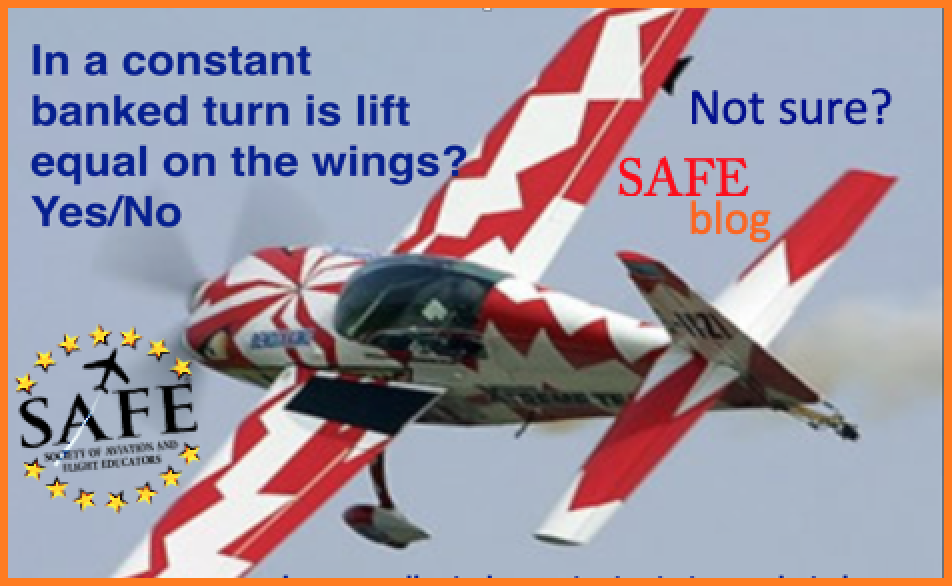
 I usually ask audiences about the balance of lift on the wings of an airplane in a stable, level altitude turn: In a level, coordinated 30-degree turn, is the lift equal on both wings? – Please make YOUR choice at this point before going further.
Reliably, more than half of the pilots in every audience will say lift is unequal on the wings in a level coordinated turn. For an educator, this is the classic “learning opportunity” to present a startling follow-up question. If lift is unequal in a stable turn, wouldn’t your plane would still be rolling? Presented that way it seems to make sense to pilots; lift is equal on the wings. Inevitably, someone always posits that the outer wing has “more lift because it is traversing a longer arc” (over banking tendency). But obviously if this was true your plane would still be rolling. I think what confuses pilots is the asymmetric lift used to create the roll initially, and I think also (surprisingly) the flight attitude is still somewhat scary to many pilots since we all spend most of our time straight and level. The fact that 70% of pilots are confused is also an opportunity to improve the understanding of our flight training community (see SAFE CFI-PRO™) We have great tools for teaching this area of flight.
 So simply prove this to yourself the next time you go flying. Roll into a 30 degree bank and add enough nose up trim (and a touch of power) to maintain a stable level altitude hands off. Fold your arms and smile; your plane will happily continue to fly in a hands-off stable turn until it runs out of fuel (assuming it is properly rigged). Every CFI needs to demonstrate this stability and explain the underlying aerodynamics very early in pilot training. This is not an automobile or a boat and ignorance of essential aerodynamics is responsible for many LOC-I accidents.
 The natural follow up question is of course, what will happen if we stall in a coordinated turn? This is a very powerful question for every aviation educator to ask (and demonstrate) as soon as a student is comfortable with straight-ahead stalls. Student pilots predictably grab the seat cushion and start to sweat when I first demonstrate a turning stall in an aircraft during training (despite a full ground briefing). >70% of pilots (and CFIs) predict a spin entry as the inevitable result of a turning stall. But if lift is equal on the wings (we are coordinated), a stall in a turn will very simply drop away from the lift vector. Try this with an experienced CFI and you will see that the stall break is even less pronounced than the straight-ahead stall. This is a way of expanding your flight envelope and proving to yourself how the basic aerodynamics of turning an airplane works. A turning stall is a very empowering maneuver for every pilot to experience. And the turning stall is an element in the private pilot ACS for this reason; it is an essential learning experience for safety and understanding.
And for that last mystery question; which control is active in a level turn? The ailerons are neutral in a 30 degree turn – take a look out at your ailerons while turning and try wiggling them. And the rudder is also neutral – because all it does is “cancel the adverse yaw” as ailerons are added to roll the plane. The active control responsible for the turn is what you added with the  trim; your elevator! And over 25% of pilots guess the rudder is turning the plane – and that would be a skid and responsible for pro-spin force – a dangerous assumption. The actual control responsible for turning in level flight is the elevator. A more complete explanation of the aerodynamics of turning are on Rich Stowell’s “Learn To Turn” course on community aviation. The fact that pilots are confused here is one reason we are providing expanded education for CFIs during our SAFE CFI-PRO™ workshop. A YouTube of Rich Stowell at the NTSB is available here.
 The (largely unknown) AOA indicator we all have in an upright airplane is how much chrome is showing on your yoke (how far back you have pulled the yoke or stick). This will reliably show your angle of attack and also is the first thing to reduce in an upset – unload! Next week we will talk about the fact that planes don’t really stall – but in fact pilots are responsible for stalling planes. Stay tuned – and fly safely out there.

Join SAFE to support our safety mission of generating aviation excellence in teaching and flying. Our amazing member benefits pay back your contribution (1/3 off your ForeFlight subscription)! Our FREE SAFE Toolkit App puts required pilot endorsements and experience requirements right on your smartphone and facilitate CFI+DPE teamwork. Our CFI insurance was developed specifically for CFI professionals (and is the best value in the business).


Tell us what *you* think!