
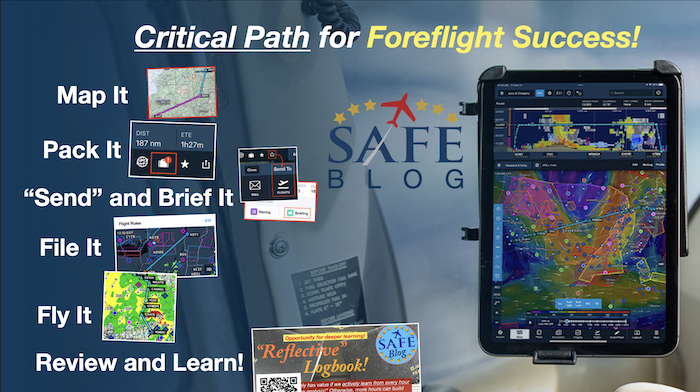
 Foreflight is an amazing toolbox of resources that saves time and provides previously unavailable planning insights. Unfortunately, many pilots I work with (testing and training) do not use this app to its full capability. An organized “critical path” approach is required for safety and success. Most tutorials focus on shiny new features and ignore the dependent essentials. It is possible to generate some amazingly stupid results without proper input and a comprehensive overview; garbage in, garbage out.
These “errors of commission/omission” have been clearly demonstrated on many checkrides – and unfortunately, in flight also – creating real hazards. This overview is intended for those new to the app and also for CFIs who believe “success is obvious” with Foreflight. The “once simple phone app” is now a very robust “planning environment.” A clear “critical path” approach must be followed for optimal results. I highly recommend *all* of these steps on *every* flight (quick and simple)!
Foreflight provides great online training HERE. But left to their own devices, new pilots often only focus on the shiny new features and miss the necessary essentials. Pilots in a hurry “hunt and peck” the smaller items and miss the bigger picture (and the necessary information *required* by CFR 91.103). Please add *your* comments below on how you use (or teach) this app. (Each one of these sections could be a whole article). For test applicants relying exclusively on your iPad to navigate (ignoring the expensive pane-mounted goodness) I can almost guarantee a “DPE-induced iPad failure.” The portable EFB is only a backup (never a primary) navigator. With that said:
Map It!


This feature seems obvious – and magical – if you ever used all those paper charts to navigate in a small GA plane any distance (esp. IFR). Just type in the start and finish and generate a straight magenta line, right? Not so fast!Solid flight planning requires examining the proposed route for obstacles. Your initial “direct” may fly over inhospitable terrain, airspace or into ugly weather. The first line is just hypothetical; please explore alternatives. Examine the GPS (going perfectly straight) option and “rubber band” your route around the problem areas. One huge advantage of Foreflight is how painlessly you can examine all these alternate planes. Always apply the 3D rule: Divert, Delay, Drive: move the courseline and/or timeline for safety.
 KITH direct KBTV takes you right over the Adirondack Mountains (more wild terrain than all the National Parks put together). Do you really want to be over that hostile area in the dark (or in winter)? Simply “rubber-banding” the route to KGLF adds only three minutes (try this) and puts you over an interstate with lots of alternate airports. If you never had an engine failure, think creatively about how “not fun” that experience can be over the mountains. Adjusting altitudes with real-time wind also reveals the most efficient altitude (but only if you have the correct aircraft profile). Foreflight “profile view” is helpful for learners who misunderstand MEFs on the sectional charts (dig a tunnel?)
Pack It!
 Unless you have Starlink running in the back of your aircraft, all that wonderful information you scan on the ground will not be with you in flight. “Packing” your flight is an essential step to ensure inflight safety and the ability to successfully “renegotiate” your planned route (stuff happens). “Packing” loads all the necessary charts and data for the trip onto your device of choice and is a must for a safe flight.
Send It –Brief It!


It is amazing how many flight test applicants have no idea this feature exists! The Foreflight Briefing tool generates a very complete overview of the “approved” weather, NOTAMs, AIRMET, SIGMETs, etc, necessary for a safe flight (or flight test). Walking through this carefully before every flight covers most of 91.103 (“all available information”) and surfaces hazards you might miss with a more casual “blue sky overview!”
File It!

Filing your plan is essential for IFR and recommended for VFR (see below). Foreflight provides both an acknowledgment *and* the actual ATC “read back” for IFR plans. The filed and actual route are stored in the flight menu and it is a simple matter to flip/flop these once you call for your clearance (no surprises). IF you have FlightStream, it even makes your old 430 useful for IFR.
Very few people ever actually file for VFR (flight following covers this). But if you ever need an “IFR pop-up,” your filed VFR plane proved information that your controller will need for faster service. Increasingly, controllers are *required* to obtain your “search and rescue” (SAR) information due to liability concerns (how many “souls on board?”) If you get into a tight corner, acquiring SAR adds an expensivedelay to the pop-up. Busy center controllers might “unable” your request due to workload (use the “E-word” if it is critical to safety).
Fly It!
 This is where Foreflight really shines; on the fly, immediate data on groundspeed and evolving weather. Running out of fuel is still the most popular way to end up in a cornfield – tracking progress is essential. Additionally, en route (ADS-B at a minimum) weather is critical, providing destination and en route updates to your flight (don’t leave home without it).
Review It!
 Not an immediate after-flight necessity, but if you want to improve as a pilot, the personal debrief (emphasized many times in this column) is a critical learning tool. Replay and grade your personal flight performance to discover areas you need to watch more carefully or improve; were you “good” or were you “lucky?” Always replay, reflect, and redirect for improved performance. Fly safely out there (and often).
Join us on Nov. 30th , at 8pm for a FREE SAFE Webinar on the new MOSAIC rules and the impact this will have on flight training.


Tell us what *you* think!